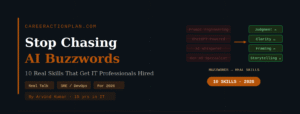
Stop Chasing AI Buzzwords — What This Post Covers
- Why "ChatGPT-powered" on your resume won't get you hired — and what actually will
- The 10 real capabilities employers value beyond AI buzzwords in 2026
- Real stories: the 400-email Slack summary, the AI breach near-miss, the EKS migration decision
- How to build each of these AI skills for career growth practically — not theoretically
- Why strategic use of AI matters more than tool fluency in 2026
- What separates "people who use ChatGPT" from "people who get promoted in an AI-enabled workplace"

If you're tired of LinkedIn gurus screaming "learn prompt engineering!" without telling you what actually moves the needle, you're in the right place.
Let me be brutally honest about the state of AI skills for career growth in 2026: the job market doesn't care if you've memorised AI buzzwords or stuffed "ChatGPT-powered" into your resume header. I've been on both sides of the table — leading teams for critical projects and interviewing candidates who think naming a tool means knowing it.
The reality is simpler and harder than the LinkedIn discourse suggests. Employers in 2026 want people who can solve real problems using a combination of tools, mindset, and practical adaptability. Naming AI tools is the entry fee — it doesn't get you the job. What gets you the job is the ten real skills below, and how thoughtfully you apply AI in service of them.
Fifteen years in IT — including the last eighteen months watching AI tools transform how my SRE and DevOps teams work — have taught me what genuinely separates the engineers who are getting promoted from the ones who are getting filtered. None of it is what the breathless LinkedIn posts claim. Here's the actual list.
The Problem With How Most People Think About AI Skills for Career Growth
Before the list, let me name the pattern I keep seeing — both in candidates I interview and in engineers I mentor.
Someone reads that "AI skills are critical for career growth in 2026." They take a 4-hour Coursera course on prompt engineering. They add "Prompt Engineering · GPT-4 · Claude · Gemini" to their LinkedIn skills section. They expect their job market opportunities to expand.
They don't.
The reason they don't is that "knowing how to prompt ChatGPT" is now table stakes. It's like listing "Microsoft Word" on a resume in 2010. Nobody is hiring for it. The differentiation has moved up the stack — to judgment, integration, and value creation on top of AI tools, not the use of the tools themselves.
The second profile isn't anti-AI. It's pro-judgment about AI. That distinction is what employers are actually paying for in 2026.
10 Real AI Skills for Career Growth in 2026 — Not Buzzwords
1 Outcome-Oriented Thinking — Knowing What You're Actually Building Toward
I once worked with a junior analyst who spent two days perfecting the colour scheme of a dashboard, ignoring the fact that the client needed actionable insights, not pixel-perfect design. The dashboard looked beautiful and answered no questions.
Employers in 2026 want people who ask "what problem are we actually solving?" before they start executing. AI tools make this skill more valuable, not less — because AI will happily generate beautiful, polished, completely wrong output if you don't define what success looks like upfront.
2 Clarity in Communication — Still the Highest-ROI Career Skill
In 2026, the noise is louder than ever. Clear, direct communication is a genuine superpower. If you can write one page that aligns stakeholders, you're more valuable than someone who can generate a 30-page AI strategy deck nobody reads.
Whether you're an engineer, analyst, or manager, your career will track your communication ability more tightly than your technical ability after a certain experience level. Can you write a clear Slack update? Can you document a runbook that someone can actually follow at 3am? Can you summarise a 60-minute meeting in five bullet points?
3 Critical Digital Judgment — Knowing When NOT to Use AI
Everyone can use AI tools. Few can decide when not to use them. This is the single most undervalued skill in AI skills for career growth conversations in 2026 — and the one that employers are quietly screening for.
Employers want people who can distinguish: when to leverage AI for speed (drafting, summarising, code scaffolding) versus when human judgment is non-negotiable (negotiations, sensitive client calls, ambiguous data interpretation, ethical edge cases, regulated environments). The candidate who pastes everything into ChatGPT looks productive in the short term and creates compliance disasters in the long term.
Strong digital judgment in 2026 means understanding: how APIs integrate systems, when no-code tools save time vs when they create technical debt, how Git workflows protect or destroy collaboration, how cloud billing models can quietly drain budgets, and which problems benefit from AI assistance vs which are made worse by it. None of this is about memorising tools. All of it is about judgment.
4 Problem Framing — The Skill That Separates Senior From Junior
I've seen teams spend six months solving the wrong problem because they never stepped back to verify the framing. The market in 2026 moves fast enough that this pattern is now expensive. Employers value people who ask "is this the right question?" before they invest weeks of work answering it.
When my team was implementing observability across a microservices architecture, the difference between good engineers and great ones wasn't who knew Prometheus best. It was who understood the system holistically — the service dependencies, the potential cascade failure modes, the business consequences of partial visibility. Great engineers caught framing errors before they became architecture decisions.
5 Cross-Functional Collaboration — Especially Important in AI-Enabled Teams
The most impactful projects I've worked on always involved deep collaboration across functions — SRE working with finance on cost monitoring, working with security on compliance-aligned alerting, working with product on user-impact metrics. AI doesn't reduce the need for this collaboration — it increases it, because AI-generated work needs review and validation from domain experts before it goes anywhere near production.
Employers in 2026 want engineers who:
Work comfortably with design, product, security, and finance teams. Ask intelligent questions outside their immediate domain. Align their technical work with business goals — and can articulate how. Take initiative when they see a problem outside their formal scope.
6 Data Fluency — Without Becoming a Data Scientist
Employers in 2026 want people who can work with data without constant handholding from analytics teams. You don't need to become a data scientist. You need to be comfortable enough with data to make decisions, spot anomalies, and ask the right next question.
Practical data fluency in 2026 means: basic SQL competency (enough to pull your own data when you need it), comfort with reading dashboards and identifying anomalies, understanding what "good" and "bad" numbers look like in your area, and the discipline to verify a number before acting on it.
7 Decision-Making Under Uncertainty
With the pace of change in tech and business in 2026, decisions increasingly need to be made with incomplete information. The engineers who freeze under uncertainty struggle. The ones who can make calculated decisions, document their assumptions, and move forward — while remaining open to course correction — are the ones who get promoted.
I learned this the hard way when deciding whether to migrate a critical workload to EKS or continue managing Kubernetes manually. We never had 100% of the information we'd have liked. We made the call based on the data we had, documented the key assumptions explicitly, and built in checkpoints to revisit the decision. That documented uncertainty became the asset — when one of our assumptions turned out to be wrong, we caught it quickly because we'd written it down.
8 Strategic Use of AI — Not Just Tool Fluency
Of all the AI skills for career growth in 2026, this one matters most. AI hype is real, but employers don't want people who can prompt-engineer their way to a slightly better blog post. They want people who integrate AI tools meaningfully into workflows in ways that produce measurable business outcomes — and who think about the ethical implications of doing so.
When using AI for log analysis, do you think about what data you're sending to a third-party service and whether that violates your company's data classification policy? Are you aware of how AI-suggested code might introduce subtle bugs or security vulnerabilities? Do you understand the difference between AI as a productivity tool and AI as a substitute for human judgment in regulated decisions?
9 Resilience Under Pressure — The Skill That Compounds
Deadlines slip. Clients change their minds. Tech breaks. Production goes down on a Sunday morning. Employers in 2026 want people who can handle chaos without becoming chaos themselves.
I've watched two very different responses to project disruption. In one case, a client cancelled a project mid-way, and one analyst started panicking about his hours, his utilisation rate, his career impact. Another team member calmly shifted focus to documenting the lessons learned, prepping handover materials, and identifying what could be reused for the next engagement. Within six months, the second person had become the go-to team member for crisis pivots. The first one quietly stalled.
Resilience isn't about being unaffected by stress. It's about staying functional and useful while you're affected.
10 Storytelling With Impact — Turning Work Into Decisions
Employers want people who can turn dry data into a narrative that moves stakeholders to act. Whether you're pitching a product, explaining a production incident, or requesting budget for tooling, storytelling is what converts "information" into "decisions."
You don't need to be a writer. You need to be able to read data trends, visualise them clearly, and explain what they mean to the business in human language.
What This List Adds Up To — The Underlying Pattern
If you've read all ten of these skills carefully, you may have noticed something: only one of them (strategic use of AI) is specifically about AI tools. The other nine are about being a better professional — judgment, communication, framing, collaboration, decision-making, resilience, storytelling.
That's the point. AI skills for career growth in 2026 are not really about AI. They're about being the kind of professional whose judgment, communication, and value creation remain valuable in an environment where AI handles more of the surface-level execution. AI raises the floor on everyone's productivity. It doesn't raise the ceiling on judgment, taste, or thinking — those still come from humans, and those are still what employers pay for.
Where Most Engineers Get Stuck — And How to Move
After fifteen years of mentoring engineers and being part of hiring decisions, I see the same pattern over and over. The engineer who reads articles like this one, agrees with the principles, and then doesn't change their daily behaviour. Three months later they're still chasing the next tool, still adding buzzwords to their resume, still hoping the next certification will create the breakthrough.
The shift requires action, not agreement. Here are the three specific habits that compound the fastest:
Write something professional every week. A 100-word Slack post, a 300-word LinkedIn post, a 500-word internal write-up. The format matters less than the consistency. Writing improves thinking, and visible thinking is what gets noticed.
Have one cross-functional conversation per month. A coffee with someone in product, security, or finance. Not a transaction — a relationship. Over a year, these become twelve real working relationships across your organisation, which is the most underrated career asset most engineers don't build.
Document one decision per month. Big or small. What you decided, what the alternatives were, what you assumed, what you'd revisit later. This habit alone — practised for two years — produces a portfolio of thinking that becomes visible in performance reviews, interviews, and informal conversations with leadership.
None of this requires learning a new AI tool. All of it compounds into the kind of profile that gets you noticed, hired, promoted — and ultimately makes you the engineer that AI tools augment rather than threaten.
Related Guides That Build These Skills
For the upskilling roadmap: Our upskilling for career growth guide covers the specific skills DevOps and SRE engineers need to build in 2026 — including the 5-hours-per-week learning plan and how to get your employer to fund it.
For practical AI integration: Our job search with ChatGPT guide covers the exact prompts that produce real value — and what AI specifically cannot do for you in a job search.
For year-end conversations about these skills: Our year-end appraisal guide covers how to translate these skills into the impact language that wins ratings and raises.
For senior-level interview demonstrations: Our guide on interview strategies for experienced professionals covers how to demonstrate judgment, collaboration, and strategic thinking — exactly the skills this post is about — in interview settings.
10 Real AI Skills for Career Growth — Quick Reference
- 1. Outcome-oriented thinking. Define what success looks like before you start. Apply the "so what?" test to every task.
- 2. Clarity in communication. The 400-email summary skill. Daily practice writing in plain English compounds faster than any technical certification.
- 3. Critical digital judgment. Knowing when NOT to use AI matters more than knowing how. Compliance, ethics, sensitive data — human judgment first.
- 4. Problem framing. Rephrase every task in your own words and verify the framing before you execute. Solves the wrong-problem trap.
- 5. Cross-functional collaboration. One small cross-functional opportunity per quarter. Real relationships across departments.
- 6. Data fluency. Basic SQL, dashboard literacy, anomaly detection. Spot the burn rate spike before it becomes a six-figure mistake.
- 7. Decision-making under uncertainty. Document your assumptions explicitly. The assumptions are the debugging tool.
- 8. Strategic use of AI. Ask "what value am I adding on top of this AI output?" If the answer is nothing meaningful, you're outsourcing thinking.
- 9. Resilience under pressure. Sleep, exercise, relationships, time off the laptop. Resilience compounds. Most professionals underinvest until they really need it.
- 10. Storytelling with impact. Four-part structure: problem, stakes, solution, result. Make it human. Convert information into decisions.