

30-60-90 Day Plan — What This Guide Covers
- Why the first 90 days shape how people see you for the next 900 — and the specific actions that build that perception deliberately
- The complete 30-60-90 day plan broken into three phases — observation, contribution, influence
- Word-for-word scripts for 1:1 conversations with your manager, peers, and skip-level
- Real examples from Arvind's onboarding into SRE roles at fintech and product companies
- The common first-90-days mistakes that quietly damage your reputation — and how to avoid each one
- A weekly reflection prompt template that becomes your promotion journal
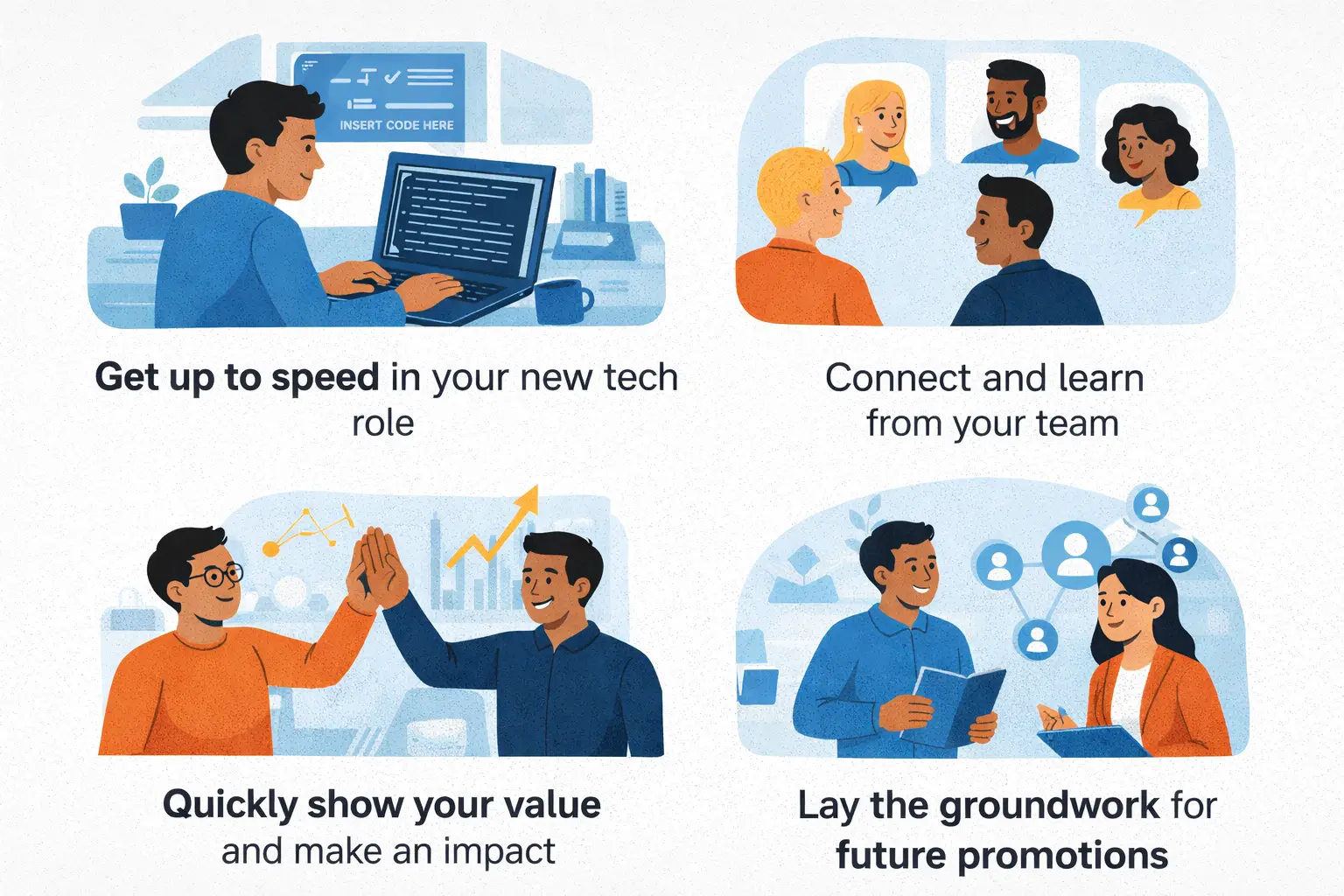
A few years ago, I joined a tech company as a Site Reliability Engineer. It was one of those moments where excitement meets pressure — the offer was strong, the team was good, and I knew the first impression mattered enormously. I also knew something most engineers don't take seriously enough: the first 90 days shape how people see you for the next 900.
Nine months later I wasn't just part of the team — I was leading a workstream. And it wasn't because I worked late nights or said yes to everything that crossed my desk. It was because I had a structured 30-60-90 day plan and I executed it deliberately, week by week.
This post is that plan. Whether you're starting your first tech job, switching companies after years in the same place, or pivoting into a new role internally — these 90 days can be the launchpad for faster growth, real influence, and earlier promotions than the standard career timeline suggests.
Let me break it down phase by phase, with real examples, the specific scripts I've used, and the proven tactics that separate engineers who quietly stall in new roles from those who accelerate.
Why the First 90 Days Matter More Than Most Engineers Realise
Before the plan, let me say something about why this specific window matters. The first 90 days in a new tech job are different from the 90 days that come before or after — for three specific reasons.
Your reputation is being formed, not maintained. Once people have a mental model of you — "she's reliable but slow," "he asks good questions but doesn't deliver," "she's brilliant but hard to work with" — that model is sticky. It can be updated, but it takes significant new evidence to change. The first 90 days are when the model is being built from scratch. You have outsized influence over what gets written into it.
You have permission to ask basic questions you'd never ask later. On day 15, "wait, why does our deployment pipeline route through Jenkins instead of GitHub Actions?" is an intelligent newcomer's question. On day 200, the same question makes you look out of touch. Use this window to ask the questions that build deep context.
The team is paying attention to you in ways they won't be later. Once you're not new anymore, you're background. While you're new, your manager, your skip-level, and your peers are actively watching how you operate. Every interaction is signalling. A 30-60-90 day plan turns this attention into accumulated career equity instead of letting it pass invisibly.
The Complete 30-60-90 Day Plan for a New Tech Job
Your primary job in the first month is not to impress people with technical wizardry. It's to listen, observe, and absorb. Think of yourself as an anthropologist for the first 30 days — studying the team's rituals, identifying the unwritten rules, understanding power dynamics, and mapping the work culture before you try to influence it.
Phase 1 Core Objectives
Understand the company culture and how decisions actually get made. Learn how your team operates — meetings, deployment cycles, code review practices, on-call structure. Build relationships with key stakeholders inside and adjacent to your team. Familiarise yourself deeply with the systems, codebases, and tools you'll be working with.
1 Schedule 1:1s Early — With the Right People
In your first two weeks, set up short, informal introductions with your manager, your immediate team, and at least three people from related departments (product, QA, security, design). These are not work meetings. They're context-building conversations. The goal is to understand how each person operates, what they care about, and what makes them successful.
"What does someone in your role need from someone in my role to be successful?"
"How do you prefer to communicate — Slack, email, scheduled syncs? What works best for you on which kinds of questions?"
"What's a current frustration or unsolved problem that you'd love someone to look at — even if it's outside my immediate scope?"
"Who else should I be talking to in my first month who'd give me a different perspective on how things work here?"
Document what you hear. These notes become your map of the organisation — who cares about what, where the unresolved problems are, and where you can add value in the months ahead.
2 Decode What Success Actually Looks Like
The biggest mistake new hires make is assuming they know what success looks like in their new role. The job description told you what the company thought it needed when they wrote it. Your manager may have a slightly different version of success in mind. Your skip-level may have an even different one.
In your first 1:1 with your manager, ask the question directly:
Follow up: "And looking at six months out, what would 'this is working really well' look like? What about 'we need to course-correct'?"
This question does three things at once. It gives you concrete, actionable clarity. It shows your manager that you think about success in their terms, not just yours. And it surfaces any mismatch between your assumptions and their expectations early enough to fix it without drama.
3 Learn the Tools and Tech Deeply — Don't Skim
The READMEs your onboarding documentation pointed you to are the starting point, not the destination. In your first 30 days:
Clone every relevant repository. Read the recent commit history — not just the code. Set up the local dev environment end-to-end. Understand the CI/CD flow: where the build is triggered, what tests run, where artefacts get stored, how production deployment happens. Map staging versus production: what's different, what's the same, what should be the same but isn't. Look at the monitoring dashboards and alerting setup — what's noisy, what's missing.
Create your own checklist for tools and access. If you find gaps in the onboarding documentation — missing context, outdated instructions, undocumented steps — offer to improve them. This is a textbook quick win: it costs you a few hours, it makes future new hires more productive, and it signals initiative without requiring any deep domain expertise yet.
4 Shadow Before You Solve
Join design reviews, code walkthroughs, incident response retros, architecture discussions — even the ones where you have no opinion to contribute yet. Listen. Take notes. Ask clarifying questions respectfully. Most senior engineers will gladly explain context if they see you're genuinely curious rather than positioning yourself.
The reason this matters: every team has decisions in its history that look strange from the outside but make perfect sense once you know the context. The engineer who shows up in week three saying "why don't we just switch to Kubernetes?" without understanding that the team tried twice and hit specific blocking issues is signalling "I don't yet have the context to have useful opinions." Spend the time to acquire that context before forming strong views in public.
5 Observe Communication Dynamics Carefully
In your first 30 days, watch how the team actually communicates:
Who drives decisions in meetings — is it the most senior person, the loudest voice, or the one with the strongest data? How are disagreements handled — direct debate, written documents, side conversations? What's the tone of internal Slack — formal, casual, GIF-heavy, emoji-light? When something goes wrong, what happens — blame, blameless post-mortem, silence?
This is not so you can mimic the culture artificially. It's so you can adapt your authentic communication style to be effective within the team's norms. A team that values blameless post-mortems will respond very differently to "we screwed up the deployment" than to "we hit an issue with the deployment — here's what we learned."
- What did I learn this week about how decisions get made here?
- Who are the three people whose perspectives I most need to understand better?
- What's one assumption I came in with that turned out to be wrong?
- What tools or systems do I still feel uncertain about?
- What's one question I should ask my manager in our next 1:1?
You've built context. You understand how the team works, who the stakeholders are, where the rough edges live. Now it's time to show you can be trusted to deliver. This doesn't mean working overtime or saying yes to everything. It means demonstrating consistency, thoughtfulness, and ownership.
Phase 2 Core Objectives
Make a visible, useful contribution — your first quick win. Build genuine confidence with peers and your manager through reliable execution. Demonstrate learning agility and willingness to take ownership of work that's slightly outside your defined scope.
1 Identify and Ship a Quick Win
A quick win is a small project that's been ignored or under-prioritised by the team, that you can complete in 2–3 days with high visibility. Look for:
A deployment script that's brittle or undocumented. A noisy alert that fires repeatedly and gets ignored. A monitoring dashboard that doesn't exist yet for a service the team relies on. A manual QA step that could be automated in a few hours. An onboarding doc that's outdated and frustrates new hires.
2 Become the Expert on One Specific Thing
Don't try to master everything in your second month — pick one tool, system, or process your team relies on frequently, and go deep on it. If it's Jenkins for builds, become the team's Jenkins person. If it's ArgoCD for deployments, learn it cold. If it's Sentry for error tracking, understand it better than anyone else on the team.
The goal is to become the go-to person for one specific thing within your first 60 days. This positions you as someone who knows things, not just someone who's still learning. It also creates natural cross-team interactions when people from other parts of the organisation need help with that tool.
3 Improve Documentation or Onboarding
The bar for documentation in most teams is genuinely low — not because anyone wants it that way, but because the people who know things never have time to write them down. As a new hire who just went through onboarding, you have unique perspective on what was confusing, what was missing, and what would have helped.
Write the doc. Update the README. Fix the broken onboarding step. Even a single well-written page that helps the next new hire ramp up faster is a lasting contribution that your manager will remember in your performance review six months later.
4 Ask for Small, Visible Responsibilities
In your one-on-ones during weeks 5–8, ask your manager:
Ideally something where I can show consistent delivery, but not so high-stakes that a learning mistake would have major consequences."
Underpromise, overdeliver — but communicate throughout. The worst thing you can do with a first ownership area is take on the work and then go quiet for three weeks. Even if the work is going well, your manager needs visibility into progress to feel confident handing you bigger things later.
5 Contribute in Retros and Planning — Constructively
Start speaking up in retrospectives and planning sessions during your second month. Share what you've observed, what was confusing during onboarding, and small experimental ideas. Be constructive, not critical — "I noticed our staging deploys take 25 minutes longer than production deploys; is there a known reason, or is that something worth investigating?" is a question that adds value. "Why do our staging deploys take so long?" is a complaint that doesn't.
- What did I ship this week? Was it visible to the right people?
- What's one piece of feedback I received — explicit or implicit — that I should act on?
- Where am I underdelivering or overpromising?
- What's the one thing I'm becoming the team's go-to person for?
- What's my plan for next week's quick win or visible contribution?
You've proven you can learn quickly. You've demonstrated you can execute reliably. Now it's time to level up your impact — because promotions aren't just about skill, they're about trust, visibility, and alignment with broader business goals.
Phase 3 Core Objectives
Demonstrate strategic thinking, not just tactical execution. Begin influencing peers and adjacent teams, not just contributing to your immediate scope. Get structured feedback that sharpens your next 90 days. Position yourself for the next level of responsibility before the formal review cycle.
1 Present Something to the Team
By day 75, you should have done something worth presenting. It can be informal — a 15-minute walkthrough in your team's weekly sync, a Slack write-up of a problem you solved, a brief tech talk at a team lunch. The format matters less than the act of presenting.
Good first-presentation topics include: a tool you evaluated and tested. A bug you fixed with a clear "here's what I learned" angle. A proposal to improve something that affects multiple teams. An analysis of your team's reliability metrics with one specific recommendation. The first phase of an improvement initiative you'd like to lead.
The presentation isn't about showing off. It's about making your thinking visible to people beyond your immediate manager — which is exactly how you build the reputation that leads to bigger responsibilities.
2 Connect Business Outcomes to Engineering Work
Too many engineers focus exclusively on code. Promotions accelerate when you align your work with customer impact and business outcomes. By day 75, schedule a conversation with your PM or a Customer Support representative:
The answers to those three questions give you a list of high-impact engineering work that has direct business alignment. Find one of those issues you can improve or surface better, and quietly start working on it. This is exactly the kind of cross-functional initiative that makes engineering managers notice you for promotion.
3 Represent Your Team Outside the Team
In your third month, volunteer for opportunities that take you beyond your immediate team:
Join an interview panel to help hire the next person on the team. Represent engineering in a product sprint review where the team gets feedback from product on what to build next. Contribute thoughtfully in an inter-team Slack channel. Volunteer to mentor a newer joiner. Show up to an internal tech talk in a different part of the engineering org and ask a good question.
Each of these increases your sphere of influence by one person, one conversation, or one team. Compound over months, this is how visibility builds without performing on LinkedIn.
4 Ask for Specific Feedback Before the 90-Day Review
Don't wait for your formal 90-day check-in to find out how you're doing. In your 1:1 around day 70–75, ask your manager:
Follow-up: "Is there anything you've noticed that I'm not seeing yet — feedback from peers, observations from cross-functional partners — that I should know about?"
Then actually act on the feedback in the remaining weeks. Feedback received and ignored damages trust. Feedback received and acted on with visible follow-through is one of the most powerful career-acceleration habits you can build.
5 Create the Vision for Your Next 90 Days
At the end of day 90, prepare a short two-slide document or one-page write-up to share with your manager:
Slide 1: Wins so far — three specific contributions with measurable outcomes. Lessons learned — two genuine observations about what's working and what isn't.
Slide 2: What I want to own next — the specific initiative, area, or expanded scope you'd like to take on in your next 90 days. The growth direction — the skills or experiences you want to build toward in the next 6–12 months.
This document does three things simultaneously: it summarises your impact for the formal review, it signals ambition and forward-thinking, and it gives your manager a concrete starting point for the next-level conversation. It's the single most powerful way to frame yourself for early leadership opportunities.
- Who outside my immediate team interacted with me this week?
- What's one piece of work I did that connected directly to a business outcome?
- What's a forward-looking opportunity I should be raising in my next 1:1?
- What feedback have I received and how am I acting on it?
- What does the next 90 days look like — and what's the version of me at day 180 I want to become?
Common First-90-Days Mistakes to Avoid
After watching many engineers go through their first 90 days at new tech jobs, here are the four mistakes I see most often — and how to avoid each one:
Mistake 1 — Trying to be a rockstar too soon. The instinct to prove your brilliance in week two is understandable but counterproductive. People promote those they trust, not just those who are technically capable. Trust is built through consistent delivery and humility, not through dramatic early demonstrations of capability. Save the bold moves for after you've built the foundation.
Mistake 2 — Overpromising in early enthusiasm. Wanting to help is great. Committing to things you don't yet have the context to deliver well is a fast way to damage your reputation. Say "I'll need to check on that and get back to you" instead of "yes, I can have that done by Friday." Realistic commitments delivered reliably beat ambitious commitments delivered partially.
Mistake 3 — Staying in your lane too long. By day 60, start looking beyond your immediate Jira board. Ask what upstream and downstream teams are working on. Show interest in the broader engineering picture. The engineers who stay narrowly focused on their assigned work past month two get pigeon-holed as executors rather than collaborators.
Mistake 4 — Being passive in 1:1s. Your manager isn't a mind reader. If something is working, say so. If something isn't working, say that too — diplomatically but clearly. Use the 1:1 to share what you're observing, what you're curious about, where you want to grow. Passive 1:1s where you wait for your manager to ask questions are a wasted resource.
The Complete 30-60-90 Day Plan Template
| Phase | Focus | Action Items | Success Metrics |
|---|---|---|---|
| Days 1–30 | Learn & Observe | Set up 1:1s with manager, team, cross-functional stakeholders. Read docs deeply. Shadow design reviews and incident retros. Map the system architecture in your own diagram. Decode success criteria with your manager. | Internal network built. Onboarding gaps identified. Success criteria documented. System architecture understood at component level. |
| Days 31–60 | Contribute | Identify and ship one quick win. Become the go-to person for one tool. Improve onboarding documentation. Ask for a small ownership area. Contribute constructively in retros. | At least one PR merged or improvement delivered. Documentation contribution visible. Feedback from peers/manager received. Recognised as the owner of one area. |
| Days 61–90 | Influence | Present something to the team. Connect with PM or Customer Support for business context. Volunteer for cross-functional work. Ask for specific pre-review feedback. Prepare next-90-days vision document. | Visibility across multiple teams. At least one initiative aligned to business outcome. Feedback received and visibly acted on. Next-90-days vision agreed with manager. |
Your Weekly Promotion Journal — Keep This
Keep a running document — Notion, Google Docs, even a notes file — that captures these five reflections every week of your first 90 days. Over twelve weeks, you'll have a complete record of your contributions, growth, and observations. This becomes your promotion journal — the document you reference during your performance review, your salary negotiation, and your next job interview.
- What did I learn this week — about the systems, the team, or myself?
- What blockers did I face, and how did I resolve them (or what's still stuck)?
- Who did I connect with this week, and what did I learn from those conversations?
- How did I add value — to my team, to a stakeholder, to a customer?
- What will I improve or do differently next week?
Final Thoughts — Promotions Begin on Day One
The first 90 days aren't about becoming a hero in your new job. They're about building trust, showing curiosity, learning the context deeply, and delivering visible impact — slowly but steadily.
People will remember how you made them feel during your onboarding more than they'll remember the specific things you shipped. They'll remember how reliable you were when you committed to something small. They'll remember whether you made their work easier or harder. Those impressions, formed across the first three months, become the foundation for everything that comes next — your first appraisal, your first stretch project, your first promotion conversation.
If you're intentional with this 30-60-90 day plan, you won't just survive your new tech job. You'll grow into a role that's bigger than what you were hired for — faster than your peers, and with less burnout than the engineers who try to brute-force their way to visibility.
Related Guides for Your New Role
For year-end appraisal preparation: The work you do in your first 90 days directly feeds into your appraisal outcome 9 months later. Our year-end appraisal guide covers how to translate first-90-days wins into strong appraisal language and how to navigate the calibration process.
For internal visibility: Building the right kind of visibility in your first 90 days is foundational personal branding work. Our guide on personal branding for DevOps and SRE engineers covers how to make your work visible to the right people deliberately.
For salary conversations down the line: A strong first 90 days sets up the negotiation leverage you'll need at promotion or external offer time. Our salary negotiation guide covers the full strategy.
For work-life balance from day one: The first 90 days are when bad work-life patterns get established and become hard to break. Our work-life balance guide for IT professionals covers how to set sustainable boundaries before they become burnout.
For mastering the role technically: If you're stepping into an SRE or DevOps role, our upskilling for career growth guide covers the specific skills to build alongside your day-to-day work.
30-60-90 Day Plan — Quick Reference
- Phase 1 (Days 1–30) — Foundation. 1:1s with stakeholders, decode success criteria, learn tools deeply, shadow before solving, observe communication dynamics.
- Phase 2 (Days 31–60) — Contribute. Ship a quick win, become the go-to person for one tool, improve documentation, ask for a small ownership area, contribute constructively in retros.
- Phase 3 (Days 61–90) — Influence. Present something, connect with PM/Customer Support for business context, represent your team outside it, ask for pre-review feedback, create the next-90-days vision document.
- Avoid the four common mistakes: trying to be a rockstar too soon, overpromising, staying in your lane too long, being passive in 1:1s.
- Keep a weekly promotion journal. Five reflection prompts. Twelve weeks of entries. This becomes the foundation for every future career conversation.
- The first 90 days shape how people see you for the next 900. Be deliberate about what perception you're building.