

Bangalore Tech Salary Guide 2026 — What This Covers
- Real Bangalore tech salary data for 2026, by role and experience — verified from multiple industry sources
- The 4 company tiers in Bangalore and how salaries actually differ between them (2-3x variation is real)
- What DevOps, SRE, Software Engineers, Data Engineers, and ML Engineers earn at each career level
- The specific salary jumps you should expect at 3, 5, 7, and 10 years of experience — and when you're falling behind
- Total compensation reality: base, bonus, stock (ESOP/RSU), and what "CTC" actually means
- How to know if you're underpaid — and the exact conversation to have with your manager or a new employer
If you're an engineer in Bangalore trying to figure out what you should be earning in 2026, you've probably already read three articles that gave you three different numbers. And when you asked friends, you got three more. The Bangalore tech salary conversation is genuinely confusing because there's no single number — it depends on your role, your experience, and most importantly, the type of company you work at.
I've been in Bangalore tech for 15 years — from an early-career engineer at an IT services company to my current SRE work. I've been through 6 job changes, negotiated multiple offers, and mentored engineers navigating exactly this question. What I've learned is that most salary articles are wrong for one specific reason: they treat "Bangalore tech" as a single market when it's actually four very different markets.
This guide is the honest Bangalore tech salary picture for 2026. Real numbers, cross-referenced from multiple sources, with the context needed to understand where YOU should fit. No hype, no rage-bait, just the actual data.
Why Bangalore Tech Salaries Are So Confusing
Before the numbers, the frame that makes them make sense. When someone tells you "a 5-year DevOps engineer in Bangalore earns 30 LPA," they're both right and wrong simultaneously. Because in the same city, at the same experience level, salaries actually range from ₹12 LPA to ₹55 LPA depending on which company category you're in.
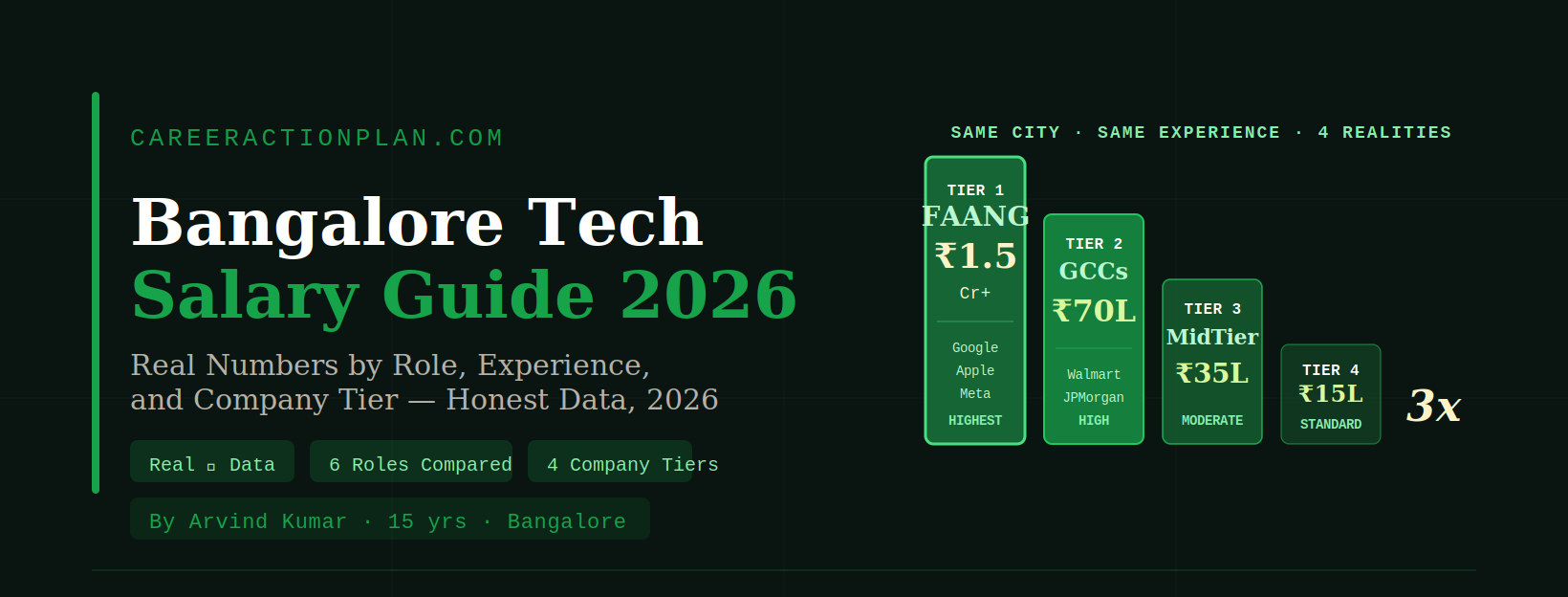
Bangalore's tech job market has four distinct salary tiers, and understanding which one you're in matters more than any other career decision you'll make this year:
The 4 Bangalore Tech Salary Tiers
This framework is the foundation for understanding Bangalore tech salary numbers. Every job posting, every offer, every career discussion falls into one of these four categories:
FAANG-Equivalent Product Companies
Google, Apple, Meta, Microsoft, Netflix, Adobe, Uber, NVIDIA, Databricks, SnowflakeSalary structure: Base 60%, Bonus 10-15%, Stock (RSUs) 25-30% of total. Stock vests over 4 years typically.
GCCs of Major US Companies + Top Indian Product Companies
Walmart Global Tech, JPMorgan, Goldman Sachs, Wells Fargo, Salesforce, Oracle, Intel, Cisco, Flipkart, Razorpay, Zerodha, Meesho, FreshworksSalary structure: Base 75-80%, Bonus 10-15%, Stock 10-15% of total. For US GCCs, stock is usually US-listed equity (real value). For Indian product companies, stock is ESOP (theoretical value until IPO).
Established Enterprises + Mid-Tier Startups
SAP, IBM, Dell, HPE, Cognizant Digital, Publicis Sapient, funded Series B-D startups, established fintech (Slice, Cred, Groww, Juspay)Salary structure: Base 85-90%, Bonus 5-10%, Stock 0-15% of total. Startup ESOPs typically vest over 4 years with 1-year cliff.
IT Services + Traditional Corporates
TCS, Infosys, Wipro, HCLTech, Tech Mahindra, Accenture, Capgemini, LTIMindtree, non-tech corporate IT departmentsSalary structure: Base 92-95%, Bonus 5-8%, Stock rarely offered. Annual increments typically 6-12% for average performers, 15-20% for high performers.
Bangalore Tech Salary — Software Engineer
The most common role — general software engineers building products, features, and applications. Total compensation (base + bonus + stock, annualised):
| Experience | Tier 1 | Tier 2 | Tier 3 | Tier 4 |
|---|---|---|---|---|
| 0-2 years (fresher/junior) | ₹35-55 LPA | ₹16-28 LPA | ₹8-15 LPA | ₹4-8 LPA |
| 3-5 years (SDE-II) | ₹55-95 LPA | ₹28-48 LPA | ₹18-32 LPA | ₹9-16 LPA |
| 6-9 years (SDE-III / Senior) | ₹85-1.6 Cr | ₹45-85 LPA | ₹28-50 LPA | ₹15-28 LPA |
| 10+ years (Staff / Principal) | ₹1.4-3 Cr | ₹75-1.4 Cr | ₹45-85 LPA | ₹25-50 LPA |
Bangalore Tech Salary — DevOps Engineer
DevOps engineers build and maintain CI/CD, infrastructure automation, and cloud environments. Salaries have appreciated significantly in 2024-26 due to demand:
| Experience | Tier 1 | Tier 2 | Tier 3 | Tier 4 |
|---|---|---|---|---|
| 0-2 years | ₹28-45 LPA | ₹12-22 LPA | ₹6-12 LPA | ₹3-7 LPA |
| 3-5 years | ₹48-80 LPA | ₹22-42 LPA | ₹15-28 LPA | ₹8-15 LPA |
| 6-9 years | ₹75-1.3 Cr | ₹38-72 LPA | ₹25-45 LPA | ₹14-25 LPA |
| 10+ years | ₹1.1-2.4 Cr | ₹62-1.2 Cr | ₹40-72 LPA | ₹22-42 LPA |
For DevOps engineers, the specific skill stack matters. Engineers with strong Kubernetes production experience, deep IaC (Terraform/Pulumi) skills, and service mesh knowledge command the upper end of these ranges. Generalists sit at the lower end.
Bangalore Tech Salary — Site Reliability Engineer (SRE)
SRE is one of the highest-paid engineering specialisations in Bangalore in 2026, especially at Tier 1 and Tier 2. Not many engineers pursue this path, and demand has outstripped supply:
| Experience | Tier 1 | Tier 2 | Tier 3 | Tier 4 |
|---|---|---|---|---|
| 0-2 years | ₹42-65 LPA | ₹18-30 LPA | ₹10-18 LPA | Rare |
| 3-5 years | ₹62-1 Cr | ₹30-58 LPA | ₹20-38 LPA | ₹10-18 LPA |
| 6-9 years | ₹95-1.7 Cr | ₹52-95 LPA | ₹32-58 LPA | ₹18-32 LPA |
| 10+ years | ₹1.5-3.2 Cr | ₹85-1.5 Cr | ₹50-90 LPA | ₹28-52 LPA |
Note that SRE roles at Tier 4 are rare — most IT services companies don't have dedicated SRE functions, they have "Production Support" which pays significantly less. If you're at IT services doing production support work, moving into an SRE role at Tier 2 is one of the highest-impact career moves possible.
He then applied to Tier 2 GCCs specifically for SRE roles. First offer: ₹35 LPA at a US GCC. That's a 4x jump in a single move. Same person, same city, similar work — just different tier. Three years later, he's at ₹65 LPA total comp at the same GCC.
Meanwhile, his colleagues who stayed at the IT services company are now at ₹18-22 LPA — a 2.5x increase over 7 years, versus his 8x increase in the same period. Same starting point, radically different outcomes based on tier choice.
Bangalore Tech Salary — Data Engineer
Data engineering is one of the fastest-growing salary categories in Bangalore 2026. Every product company needs strong data infrastructure, and the specialisation commands a premium:
| Experience | Tier 1 | Tier 2 | Tier 3 | Tier 4 |
|---|---|---|---|---|
| 0-2 years | ₹32-52 LPA | ₹14-25 LPA | ₹8-14 LPA | ₹4-8 LPA |
| 3-5 years | ₹52-88 LPA | ₹25-48 LPA | ₹18-32 LPA | ₹9-15 LPA |
| 6-9 years | ₹80-1.5 Cr | ₹42-80 LPA | ₹28-50 LPA | ₹15-28 LPA |
| 10+ years | ₹1.3-2.8 Cr | ₹70-1.3 Cr | ₹45-85 LPA | ₹25-45 LPA |
Skills that command the upper end: Kafka/Kinesis at production scale, Flink or Spark Streaming, data lake architecture, cost optimisation at scale. If you're pivoting into data engineering, our data analyst career switch guide covers the honest roadmap.
Bangalore Tech Salary — ML/AI Engineer
The highest-paying engineering specialisation in Bangalore 2026. Genuine ML engineers (not "prompt engineers") who can operationalise ML systems at scale command exceptional salaries:
| Experience | Tier 1 | Tier 2 | Tier 3 | Tier 4 |
|---|---|---|---|---|
| 0-2 years | ₹45-72 LPA | ₹22-38 LPA | ₹12-22 LPA | ₹6-12 LPA |
| 3-5 years | ₹72-1.2 Cr | ₹38-70 LPA | ₹25-45 LPA | ₹12-22 LPA |
| 6-9 years | ₹1.1-2 Cr | ₹62-1.1 Cr | ₹42-72 LPA | ₹22-42 LPA |
| 10+ years | ₹1.8-3.5 Cr | ₹1-1.8 Cr | ₹65-1.2 Cr | ₹38-68 LPA |
Understanding "CTC" vs Take-Home Pay
One of the biggest confusions in Bangalore tech salary discussions: CTC (Cost to Company) numbers vs actual take-home. Here's the reality:
What "₹30 LPA CTC" Actually Means
A typical breakdown for a ₹30 LPA CTC offer at a Tier 2 company:
Fixed Base Salary: ₹22-24 LPA (this is what appears on your monthly payslip)
Variable Bonus: ₹2-3 LPA (paid quarterly or annually, often prorated based on performance)
Retirement/PF/Gratuity: ₹1-1.5 LPA (locked until retirement)
Other benefits (health insurance, meal cards, etc.): ₹1-1.5 LPA (theoretical value)
Stock/RSU: ₹2-4 LPA annualised (vests over 4 years)
Monthly Take-Home Calculation
For a ₹30 LPA CTC → typical monthly take-home is ₹1.4-1.7 lakhs after tax, PF, insurance, and other deductions. That's roughly 55-60% of the "annualised base." First-timers are often shocked by how much lower take-home is than the impressive CTC number.
The Salary Progression You Should Expect
If you're wondering "am I on track?" — here's the honest progression framework, assuming you make strategic career moves:
1 Year 0-3: Foundation Building
In the first 3 years, prioritise skill development over compensation. If you're at Tier 1 or 2, great — you have the strongest foundation. If you're at Tier 3 or 4, focus on building portfolio, contributing to open source, and getting production experience with in-demand technologies. Salary target: ₹8-25 LPA depending on tier.
2 Year 3-5: The Tier Jump
This is when the tier jump matters most. If you're at Tier 4, start seriously applying to Tier 2 GCCs. Your comparative advantage — production-scale experience, cross-cultural collaboration — is valuable. Target: 60-100% salary increase through a tier jump. Post-jump salary: ₹18-45 LPA.
3 Year 5-8: Specialisation Premium
This is when specialisation pays off. Generic "software engineer" salaries plateau around 40-50 LPA at Tier 2. Specialists in SRE, ML, security, or platform engineering can push to 60-90 LPA. Focus your work on becoming genuinely expert in one high-value area.
4 Year 8-12: Staff-Level Transition
This is where compensation growth accelerates dramatically at Tier 1 and Tier 2. Staff/Principal-level roles at Tier 1 command ₹1 Cr+ total compensation. Even at Tier 2, Staff SREs and Staff Platform Engineers routinely earn ₹80-100 LPA. Your differentiation now is technical judgment + cross-team influence.
5 Year 12+: The Compounding Phase
For engineers who reached Staff/Principal by year 10-12, compensation compounds significantly. Distinguished Engineer and Fellow-level roles at Tier 1 pay ₹2-4 Cr. The IC track at this stage often out-earns management track. See our post on SRE vs DevOps vs Platform Engineering for the honest path comparisons.
How to Know If You're Underpaid
Three signals I use to help engineers assess whether they're being underpaid for their Bangalore tech salary in their current role:
Signal 1 — Your CTC is Below the 25th Percentile for Your Tier
Look at the salary tables above. If your current CTC is below the 25th percentile of your role, experience level, and company tier, you're underpaid. This is a factual signal, not opinion. Time to negotiate or start job searching.
Signal 2 — Recruiter Outreach Volume
If you're at a Tier 2 or Tier 1 company with 5+ years of experience and getting 0-1 recruiter InMails per month on LinkedIn, either your profile is underpositioned (fix with our LinkedIn profile checklist) or you're in a niche that's not currently in demand. If you're at Tier 3-4 and getting 3+ InMails per month, you have leverage — use it.
Signal 3 — Peer Comparison Within Your Company
Talk to peers (in the same company, similar role and experience). If you're 20%+ below the median, you're underpaid within your own company. In Indian tech culture this conversation is awkward, but it's genuinely useful. Some engineers use anonymous forums (Blind, Grapevine) to gather this data.
The Uncomfortable Truth About Bangalore Salary Growth
Two things nobody wants to say clearly, but should be said:
First: Loyalty to a Tier 3 or Tier 4 employer for more than 3-4 years typically costs you ₹20-50 lakhs in cumulative earnings over a career. Internal promotions and appraisals in these tiers don't keep pace with market rates. If you're planning to stay at the same company for 5+ years, you need to be genuinely certain the non-monetary benefits (flexibility, work-life balance, learning) are worth the compensation gap.
Second: The compensation ceiling at Tier 4 IT services companies is roughly ₹35-50 LPA for even the strongest 10-year performers. If your ambition is above this, you WILL need to change companies. It's not a matter of working harder or performing better — the ceiling exists structurally.
What You Should Do With This Information
Concretely, based on where you are now:
If you're at Tier 4: Start researching Tier 2 GCCs today. Your comparative advantage is real. See our job search strategies guide for the tactics that work when moving from IT services to GCCs.
If you're at Tier 3: Assess honestly whether your goals require Tier 2. If yes, target specific Tier 2 GCCs where your skills match. If no (many people genuinely prefer Tier 3 culture), focus on becoming a top performer in your current tier.
If you're at Tier 2: The tier jump to Tier 1 is possible but requires exceptional preparation. Alternatively, deepen your specialisation and push toward Staff/Principal levels within Tier 2. Both paths lead to strong compensation.
If you're at Tier 1: You're in the top compensation bracket in Indian tech. Focus on career growth, technical impact, and long-term wealth building through stock. Job hopping frequently at Tier 1 can hurt your total comp if you leave before stock vests.
External Resources for Verification
For engineers who want to cross-verify Bangalore tech salary numbers independently:
AmbitionBox Salary Reports — India-specific, verified from employee submissions.
Michael Page India Salary Guide — annual comprehensive report by role and city.
Levels.fyi India — specifically strong for Tier 1 and Tier 2 companies with verified offer data.
NASSCOM Research — industry aggregate data on compensation trends.
Related Guides for Compensation and Career Growth
For the broader market context: Our Tech Job Market in India 2026 analysis covers what's happening across GCCs, IT services, and product companies with hiring data.
For salary negotiation: Our salary negotiation guide covers the exact scripts that recover ₹3-8 lakhs on most senior-level offers.
For counter offers: Our guide on how to negotiate a counter offer covers when to accept and when to walk away.
For the specialisation choice: Our SRE vs DevOps vs Platform Engineering guide covers the salary and career path differences.
For the job search itself: Our job search strategies guide covers the 12-week structured plan for tier jumps.
Bangalore Tech Salary Guide 2026 — Quick Reference
- Bangalore tech has 4 salary tiers — same city, same role, same experience can pay 2-3x differently.
- Tier 1 (FAANG-equivalent product companies): Highest pay, hardest interviews, heavy stock component.
- Tier 2 (GCCs + top Indian products): Largest and fastest-growing tier. 60-70% of Tier 1 comp.
- Tier 3 (Established enterprises + mid-tier startups): 40-50% of Tier 1. Solid middle.
- Tier 4 (IT services + traditional corporates): 25-35% of Tier 1. Compensation ceiling ~₹35-50 LPA.
- SRE and ML Engineers have the highest specialisation premium in 2026.
- DevOps and Data Engineers are close behind, especially with production-scale experience.
- The tier jump from Tier 4 to Tier 2 is the highest-ROI career move in Indian tech — typically 2-3x salary in a single change.
- CTC is not take-home: monthly take-home is typically 55-60% of annualised CTC after tax and deductions.
- To know if you're underpaid: check if your comp is below the 25th percentile for your role/experience/tier.
- The compensation gap is structural, not merit-based. Great engineers exist at all tiers; the salary differences are about company category, not individual talent.
- Loyalty tax is real: staying at Tier 3/4 for 5+ years typically costs ₹20-50 lakhs in cumulative career earnings.