
Questions to Ask Your Interviewer — What This Guide Covers
- Why the questions to ask your interviewer at the end of the interview matter more than most engineers realise
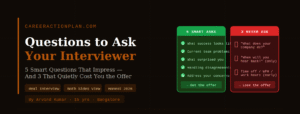
- 5 smart questions to ask your interviewer that reveal what really matters about the role
- 3 questions to NEVER ask your interviewer — and why each one damages your candidacy
- How Arvind reads the answers from the interviewer's side — what signals a "yes" vs a "no"
- The one question that impresses hiring managers 90% of the time
- Advanced patterns — different questions for different interview rounds (peer, manager, skip-level)

The last 5 minutes of any interview are the most underused. Somewhere around the 45-minute mark, the interviewer wraps up their questions and says: "So, do you have any questions for me?"
This is not a courtesy. It's a final evaluation. The questions to ask your interviewer at this moment reveal your priorities, your thinking, and your genuine interest in the role. And engineers who get this wrong — either by saying "no, I think you covered everything" or by asking obvious surface questions — quietly lose the offer they were about to win.
I've been on both sides of this exact moment. I've been the candidate who answered the technical rounds well but bombed the "do you have any questions" segment. And I've been the interviewer who scored candidates lower not because their answers were weak, but because their questions revealed something concerning.
This post is what I've learned from those experiences — the 5 smart questions to ask your interviewer in 2026 that consistently work, and the 3 questions engineers ask that quietly damage their candidacy. All from real interviews, real experiences, and honest advice you can use for your next interview.
Why the Questions You Ask Matter More Than You Think
Here's what most engineers don't realise: the "do you have any questions" segment is when the interviewer transitions from evaluating your technical ability to evaluating your judgment. Everything until that moment tested whether you can DO the job. This segment tests whether you'll be good to work with, whether you think strategically, and whether you're genuinely interested.
Three specific things I evaluate as an interviewer during this segment:
1. What you're prioritising. If your first question is about salary bands, that tells me one thing. If it's about the team's technical debt situation, that tells me another. Neither is wrong — but the pattern of what you ask reveals what matters to you.
2. How much research you did. The quality of your questions signals whether you spent 20 minutes on the company website or actually understood the product, the team, and the current challenges. In 2026, with LinkedIn and public engineering blogs, there's no excuse for surface-level research.
3. What kind of colleague you'll be. Thoughtful, forward-looking questions signal you'll be a thoughtful colleague. Combative or entitled questions signal the opposite — and interviewers extrapolate from a small sample.
5 Smart Questions to Ask Your Interviewer in 2026
These are the questions to ask your interviewer that consistently earn respect from interviewers and give you genuinely useful information about the role. I've asked most of these in interviews I've taken; I've been asked all of them in interviews I've conducted. They work.
"What does success look like in this role in the first 6 months — and what would 'we need to course-correct' look like?"
Why it works This question does three things at once. It signals you think about outcomes, not just tasks. It surfaces the interviewer's real expectations (which are often different from the JD). And it opens the door to a genuine conversation about the role's actual challenges. Watch for hesitation in the answer — if they can't clearly describe success, the role's expectations aren't well-defined internally, which is a caution flag.
"What's a specific problem the team is working on right now that you'd want the person in this role to help with?"
Why it works This shifts the conversation from abstract job description to concrete reality. It also positions you as someone who thinks about contribution, not just compensation. The answer tells you what the day-to-day work will actually feel like. If the answer is vague or generic ("we work on many things"), that's a signal about how well the team's priorities are defined.
"What's something about working here or on this team that surprised you when you joined?"
Why it works This question is disarming and honest. Interviewers rarely get asked it, and the answers are usually genuinely revealing — both the positive surprises (which tell you what makes the team special) and the negative ones (which tell you what to watch out for). It also signals emotional intelligence on your part. In 15 years of interviewing, this is the question I remember candidates asking me most vividly.
"How does the team handle it when a decision needs to be made but there's disagreement about the right approach?"
Why it works This is a culture question disguised as a process question. The answer reveals whether the team debates openly, defers to seniority, uses data-driven decision-making, or has broken decision-making processes. Especially valuable for infrastructure/platform roles where technical disagreements are common. If they can't clearly answer, that itself is data.
"Based on our conversation so far, is there anything about my background you'd like me to clarify or expand on before we wrap up?"
Why it works This is the single most powerful closing question. It's a graceful invitation for the interviewer to voice any hesitations they have — while there's still time for you to address them. Most interviewers will say "no, we covered everything" (which is fine) — but occasionally they'll surface a concern you can then answer directly. I've personally saved at least two interview outcomes with this question by clearing up misunderstandings that would have cost me the offer.
3 Questions to NEVER Ask Your Interviewer
Now the equally important other side: three questions to ask your interviewer that immediately damage your candidacy. I've watched strong candidates lose offers on these exact questions.
"So, what does your company do?"
Why it damages your candidacy This signals you didn't do 15 minutes of research before showing up. Every company has a website, About page, and usually a LinkedIn presence. Not knowing what the company does implies you don't care enough to prepare. Even worse: engineers sometimes ask this in the FINAL round — meaning multiple previous interviewers told them things they clearly didn't absorb. If you're unclear on something specific, ask that specifically ("I read about X on your website — could you help me understand how that fits with Y?"). Never ask this in the generic form.
"When can I expect to hear back?" (as your only question)
Why it damages your candidacy Nothing wrong with asking about timeline — but if it's the FIRST and ONLY thing you ask, it signals that the role is a transaction, not something you're genuinely interested in. It also creates a subtle sense that you're anxious rather than confident. Better approach: ask 2-3 substantive questions about the role first, then close with a brief timeline question like "when should I expect to hear about next steps?" — which is direct without being your only priority.
"How much time off do you get?" / "What's the work-from-home policy?" / "How flexible are the working hours?"
Why it damages your candidacy These questions matter — genuinely, they do. But asking them in the interview flags you as prioritising time OFF the job before you even have the job. All three should be addressed AFTER an offer is extended, in the negotiation phase, when you have leverage and it doesn't affect the hiring decision. There's a huge difference between "what's your remote work culture" (fine) and "how many days can I work from home" (raises alarms). If you must ask about flexibility during the interview, frame it around impact: "How does the team collaborate when working across locations?" — much stronger framing.
Advanced — Different Questions for Different Interview Rounds
Not every question fits every interview stage. Here's how the questions to ask your interviewer should shift depending on who you're talking to:
Round 1 — Recruiter Screen
This round is about mutual filter. Ask process-oriented questions:
"What does the full interview process look like?"
"What's the compensation range you're targeting for this role?"
"How does this role fit into the team's near-term hiring plans?"
"What's the story behind why this role is open — new headcount or backfill?"
Round 2 — Peer / Team Interview
This round is about culture and collaboration. Ask people-focused questions:
"What does your day-to-day look like on this team?"
"What's something the team recently shipped that you were proud of?"
"What's currently frustrating about working here — even if it's small?"
"How does the team give and receive feedback in code review or design reviews?"
Round 3 — Hiring Manager
This round is about strategy and expectations. Ask outcome-focused questions:
"What does success look like in this role in the first 6 months?"
"What's the team's biggest challenge over the next 12 months?"
"How do you develop the engineers on your team — what does growth look like here?"
"What kind of person has struggled in this role in the past — what didn't work?"
Round 4 — Skip-Level / Director
This round is about vision and org direction. Ask strategy-focused questions:
"How does this team fit into the broader engineering org's direction?"
"What's the biggest bet your org is making over the next 18 months?"
"What kinds of ideas have engineers on your team pushed forward that became real work?"
"How do you think about the tradeoff between speed and quality in your org?"
He paused, then said honestly: "I'm slightly worried you've never led an incident with more than 3 million users impacted." I hadn't — but I had led a P1 incident affecting the entire payments flow for a fintech serving 800,000 daily active users, which I'd only briefly mentioned earlier. I spent 4 minutes walking him through that incident in detail — the escalation, the communication with leadership, the post-mortem.
I got the offer. He later told me if I hadn't shared that story, he would have "leaned no" based on his concern about scale experience. The question that saved the interview was the one where I asked for his hesitations.
How to Read the Interviewer's Answers
The questions to ask your interviewer are only half the equation. The other half is reading the answers strategically. Three signals I've learned to watch for:
Vagueness = problem. If you ask "what does success look like in this role" and get a generic answer like "just do good work," that's a signal the role's expectations aren't well-defined. This makes performance reviews subjective and career growth unpredictable. Follow up with: "Could you give me a specific example of what strong performance looked like from the last person in a similar role?"
Overly positive = incomplete. If every answer paints the team as perfect and there are "no real challenges," that's not honesty — that's a pitch. Real teams have real challenges. If they can't share any, they're either not being straight with you or they don't have enough self-awareness to identify their own problems.
Alignment on hard things = good sign. If you ask two different interviewers about the same challenge (e.g., "what's the biggest technical challenge the team is facing?") and get similar substantive answers, that's a strong positive signal. The team has shared context on their reality. If you get wildly different answers, there's likely more fragmentation than the team realises.
The Post-Interview Question — What to Ask Yourself
After every interview, before you leave the room or close the video call, ask yourself two questions:
1. Based on what I heard, do I actually want this role? Interviews are two-way. You're evaluating them too. Sometimes strong candidates get offers they should decline — and the seeds of that decision are in the interviewer's answers, not just their offer letter.
2. Is there anything I want to email the interviewer to reinforce or clarify? Within 24 hours, a thoughtful follow-up email addressing something specific that came up in the interview can shift you from "strong candidate" to "the one." Not a generic thank-you — a specific reinforcement of a point you made or an idea you had after the conversation ended.
Our detailed guide on when and how to send a thank you email after your interview covers the exact templates and timing that work.
External Resources Worth Reading
For deeper context on interview dynamics:
Harvard Business Review's list of 38 smart interview questions — good for broader inspiration beyond tech roles.
The Muse's comprehensive question library — organized by round and role type.
First Round Review on engineering manager interviews — specifically useful if you're interviewing for or with engineering leadership.
Related Guides for Interview Preparation
For the complete interview strategy: Our complete interview strategies guide for 2026 covers the STAR method, 48-hour prep checklist, and word-for-word scripts for the hardest questions.
For the opening question: Our guide on how to answer "tell me about yourself" in tech interviews covers the 4-part structure and 3 sample answers for junior, mid, and senior engineers.
For experienced professionals: Our interview strategies for seasoned professionals covers overqualification objections and how to reframe your background at senior levels.
For virtual interviews: Our virtual interview tips guide covers the technical setup, engagement tactics, and body language that distinguish strong virtual interviews.
For the follow-up: Our guide on the thank you email after an interview covers timing, templates, and how to recover if the interview didn't go well.
For when the offer arrives: Our salary negotiation guide covers scripts that recover ₹3–8 lakhs on most senior-level offers.
Questions to Ask Your Interviewer — Quick Reference
- The "do you have any questions" segment is not a courtesy. It's a final evaluation of your judgment and priorities.
- Question 1: "What does success look like in this role in the first 6 months?" — reveals real expectations.
- Question 2: "What's a specific problem the team is working on right now?" — shifts to concrete reality.
- Question 3: "What's something that surprised you when you joined?" — surfaces honest culture signals.
- Question 4: "How does the team handle disagreements on decisions?" — reveals decision-making culture.
- Question 5: "Is there anything about my background you'd like me to clarify?" — the closing question that saves offers.
- Never ask: "What does your company do?" — signals no research.
- Never ask (as first/only question): "When can I expect to hear back?" — signals transactional interest.
- Never ask early: Time off, WFH policy, working hours — save for post-offer negotiation.
- Prepare 6-7 questions, use 3-4 based on how the interview flows. Don't read from a list.
- Different rounds need different questions: recruiter = process, peers = culture, manager = strategy, skip-level = vision.
- Read the answers strategically: vagueness = problem, overly positive = incomplete, alignment across interviewers = good sign.