

Key Takeaways — IT Services vs Product vs GCC India
- IT services gives you breadth and job security but caps salary growth after 6–7 years
- Product companies pay 30–60% more at mid-senior levels but have brutal interview filters and slower hiring cycles
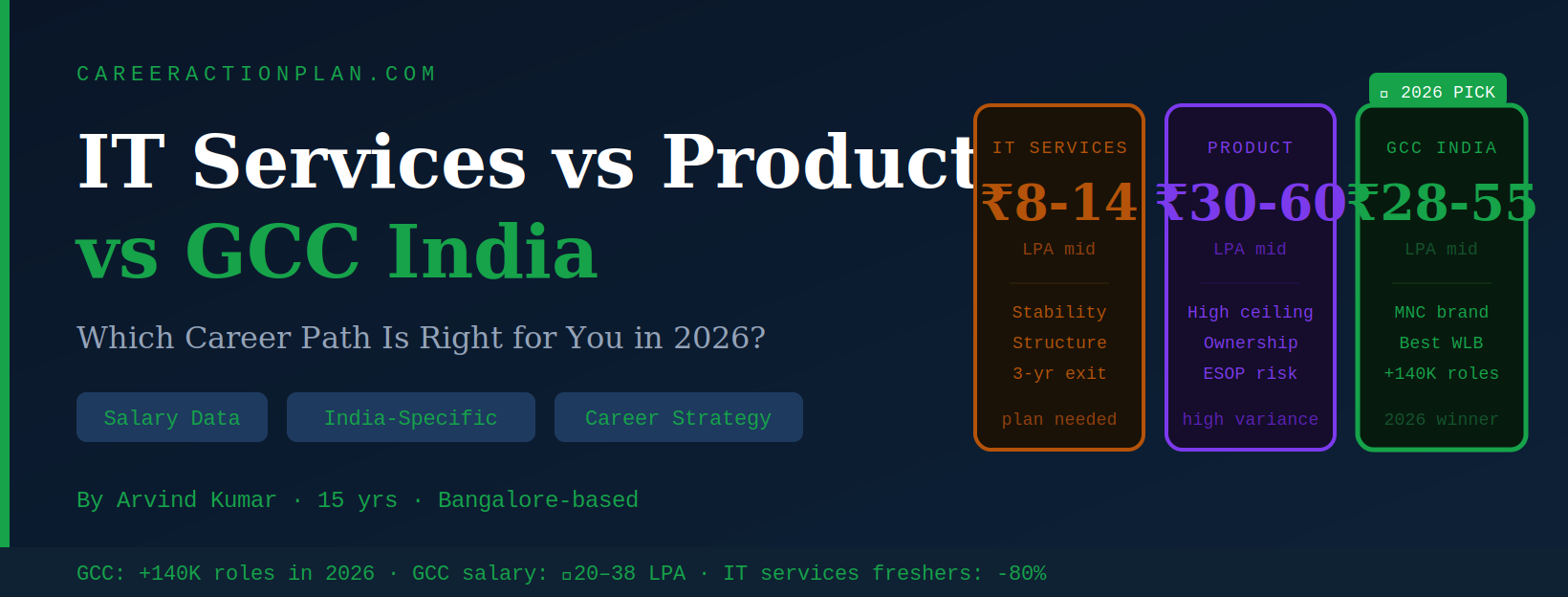
- GCCs offer the best salary-to-stability ratio in 2026, with +140K new roles expected and MNC brand credibility
- The right answer depends on your experience level, financial situation, and risk appetite — not generic advice
- Most engineers in India will cycle through all three; knowing when to move is the real skill
Every few weeks, someone messages me on LinkedIn with a variation of the same question: "Arvind bhai, I have offers from Infosys, a product startup, and a JP Morgan GCC. Which one should I take?"
I've been on all three sides of this. Started in IT services, spent years in product companies, and now work closely with GCC engineering teams as an SRE. The honest answer to IT services vs product vs GCC India is not what most blog posts give you. It depends on your level, your finances, and what you actually want from the next five years.
This post is the breakdown I wish I had when I was making those decisions.
What IT Services vs Product vs GCC India Actually Means in 2026
Before comparing, let's be precise. The Indian tech landscape in 2026 has three distinct tracks, and they've diverged further than ever:
IT Services (TCS, Infosys, Wipro, HCL, Tech Mahindra, Cognizant) — These companies build and maintain software for clients, typically Fortune 500 firms in the US and Europe. You work on client projects, often on-site at client premises or in a delivery centre. Business model is contract-based. Your job is stable as long as the client account is stable.
Product Companies — Indian-origin startups (Zepto, CRED, Razorpay, Swiggy, PhonePe) and global product firms with Indian R&D centres (Google, Microsoft, Amazon, Atlassian, Adobe). These companies own the product they ship. Engineers here directly impact the product roadmap. Higher compensation, higher risk, more volatility.
GCCs (Global Capability Centres) — Captive tech centres of MNCs like Goldman Sachs, JPMorgan, Walmart, Boeing, Siemens, Samsung. Not outsourced vendors — these are internal engineering teams doing real product work for the parent company. The fastest-growing track in India right now: +140K new roles projected in 2026 alone.
The confusion between these three tracks costs Indian engineers years of misaligned career decisions. So let me go dimension by dimension.
Salary: Where IT Services vs Product vs GCC India Diverge the Most
I'm going to give you real market numbers. These are 2026 figures for Bangalore, sourced from AmbitionBox salary data, Naukri JobSpeak reports, and what I see in my professional network. Adjust 10–15% downward for Hyderabad and Pune.
Salary Comparison — Software Engineer (3–5 Years Experience)
Salary Comparison — Lead/Staff Engineer (8–12 Years Experience)
The gap between IT services and the other two widens dramatically after 5 years. In services, your CTC grows 8–12% per year through increments. In product and GCC, you can 2–3x your salary in a single switch if your skills align with what they need.
Job Security: The IT Services vs Product vs GCC India Reality Check
This is where most comparisons get it wrong by oversimplifying.
IT Services: More stable than people give it credit for — until it isn't. Large services firms don't typically lay off experienced engineers en masse. But they do run bench programmes that are quietly stressful. If you spend more than 60 days on bench, the pressure to accept any project begins, often forcing you into technologies or client sectors you never wanted. The real job insecurity in IT services is skill stagnation — you become indispensable to one client's legacy stack and invisibly unemployable everywhere else.
Product Companies: High volatility, and 2024–2025 proved it. Indian startups have gone through significant restructuring rounds. The rule of thumb I give to engineers: the higher the funding-to-revenue ratio, the higher your layoff risk. Pre-IPO startups are a specific gamble — the ESOPs could be life-changing or worthless. Profitability-stage product companies (Razorpay, Zepto, PhonePe) are significantly safer in 2026 than series-B funded ones.
GCCs: Best of both worlds on paper, and largely true in practice. The India GCC is a cost centre for the parent company — which means India headcount is protected as long as the parent's overall business is healthy. When Goldman Sachs globally faces pressure, they don't cut India GCC; they cut New York. When Walmart Global Tech faces pressure, India stays because we're cheap relative to US headcount. This structural protection is real. GCC layoffs in India have been substantially lower than both IT services restructuring and startup downturns.
The Full Comparison Table: IT Services vs Product vs GCC India
| Dimension | IT Services | Product Company | GCC India |
|---|---|---|---|
| Entry Salary (0–3 yrs) | ₹3–8 LPA | ₹10–25 LPA | ₹8–18 LPA |
| Mid Salary (5–8 yrs) | ₹12–20 LPA | ₹30–60 LPA | ₹28–55 LPA |
| Job Security | Medium | Low–Medium | High |
| Technical Depth | Low–Medium | High | High |
| Work-Life Balance | Varies by client | Startup: poor | Generally good |
| Interview Difficulty | Low | Very High | Medium–High |
| Onsite / Travel | Common (client site) | Rare | Occasional |
| Brand Value (Resume) | Medium | High (FAANG) | High (MNC) |
| Ownership of Work | Low (client-defined) | High | Medium–High |
| ESOP / Equity | None | Common (risk) | ESPP at some firms |
| Freshers Hiring (2026) | Down 80% | Selective | Growing |
Career Growth: How IT Services vs Product vs GCC India Shape Your Trajectory
This is the dimension that matters most over a 10-year horizon, and the one most engineers underweigh when making their first or second company switch.
The IT Services Growth Ceiling
In IT services, your first 4 years can be genuinely excellent. You work on large enterprise systems, you learn to navigate client environments, you pick up project management fundamentals, and you build skills in communication and stakeholder management that product engineers often lack.
The problem starts around year 5–6. The promotion path in services firms diverges: you either move into delivery management (less technical) or stay technical but hit a ceiling where your pay band doesn't grow without shifting to a managerial track. Engineers who want to remain IC (Individual Contributors) in deeply technical roles find that IT services firms structurally don't value that path the way product and GCC environments do.
Also critical in the context of IT services vs product vs GCC India choices: services experience is discounted by product and GCC hiring managers. Not unfairly — it reflects a real signal. If you've spent 8 years maintaining a client's SAP environment, your system design and scalability thinking is likely less developed than a peer who spent the same 8 years at a product firm owning a distributed system end-to-end.
Product Company Growth: High Ceiling, High Variance
Product companies — especially Indian unicorns and FAANG — have the clearest IC ladders in the industry. Staff Engineer → Principal → Distinguished Fellow tracks exist with genuine differentiation in scope and compensation. If you want to be a deeply technical career IC at 45 years old earning ₹1 Cr+, product is the path.
The variance comes from company risk. Two engineers join similar-stage startups in 2021. One's company IPOs successfully. One gets acquired at a down round. Same technical growth, wildly different financial outcomes.
GCC Growth: The Underrated Path
GCC career ladders mirror the parent company's global bands. A Principal Engineer at Goldman Sachs GCC Bangalore is on the same global band as a Principal Engineer in New York — same title, same scope expectations, significantly different base pay but increasingly aligned total compensation.
What GCCs offer that neither services nor startups do: global visibility without relocation pressure. You can lead a globally distributed team, architect systems used by millions, and build a resume that's credible in London, Singapore, or New York — while staying in Bangalore.
Work Culture: What IT Services vs Product vs GCC India Feels Like Day-to-Day
I want to be honest here because most blog posts romanticise product culture and unfairly demonise services.
IT services day-to-day: Heavily process-driven. Timesheets, escalation matrices, client approvals for every change. If you're someone who values structure, clear deliverables, and predictable working hours, this can work. If you're someone who wants to make autonomous technical decisions, it will frustrate you deeply.
Product startup day-to-day: Move fast, break things (sometimes literally). Low process, high ownership, high ambiguity. You might ship a feature to 10 million users one week and spend three weeks in an emergency war room fixing the fallout. The engineers who thrive here love ambiguity and find process suffocating. The engineers who burn out here are the ones who need clear requirements and defined sprint boundaries.
GCC day-to-day: This varies enormously by parent company culture. Amazon GCC teams run two-pizza team structures with high autonomy. JPMorgan GCC has heavy compliance and review processes. Walmart Global Tech runs agile sprints similar to their US engineering org. Do your homework on the specific GCC's working culture — don't judge all GCCs by the same yardstick.
Who Should Choose What: My Honest Advice by Experience Level
Here's the framework I actually use when engineers ask me about the IT services vs product vs GCC India decision:
Freshers and 0–2 Years Experience
If you get into a GCC directly out of college or with 1–2 years of experience: take it. In 2026, with IT services freshers hiring down by 80%, GCCs are actively the best entry point for strong candidates. The learning curve is steeper than services onboarding, but the technical foundation you build is dramatically better.
If you can only get into IT services: take it, but treat it as a 3-year stepping stone with a deliberate exit plan. Build cloud skills (AWS/GCP/Azure), contribute to open source, get certified, and plan your first switch by year 3.
Product startups at 0 years of experience: hard to crack, high upside if you can, but don't let FOMO push you into a series-A startup with questionable unit economics over a solid GCC offer.
3–6 Years Experience
This is the most consequential decision window of your career. The gap between IT services vs product vs GCC India compensation is widest right here — and the compounding effect of the next 5 years is enormous.
If you're currently in IT services: this is the window to exit. Your services experience is still relatively recent, meaning product and GCC hiring managers will overlook it more readily than they would for someone 8 years in. Prepare seriously for system design and DSA. I've written a detailed guide on how to get into a GCC in India that walks through the 8-week preparation framework.
If you're choosing between product and GCC: GCC wins if you have any financial responsibilities (EMI, family, school fees). Product wins if you have a runway and genuinely believe in the company's trajectory. Don't join a pre-product-market-fit startup at this stage unless your financial position allows for a 40% salary cut if it fails.
7–12 Years Experience
At this stage, you know what you want. The decision becomes less about category and more about the specific role, team, and manager. A bad team at a great product company is worse than a great team at a solid GCC. Do your due diligence on the hiring manager, not just the company brand.
Check the questions to ask your interviewer before you finalise any offer — the answers will tell you more about day-to-day reality than the JD ever will.
The SRE/DevOps Angle: IT Services vs Product vs GCC India for Infrastructure Engineers
Since a large chunk of my readers are SRE, DevOps, or Platform engineers, let me address this specifically.
In IT services, SRE and DevOps roles are often hybrid — part DevOps, part system admin, part change management. The tooling tends to lag behind industry standards by 2–3 years. You'll see Jenkins where the rest of the world uses GitHub Actions, and on-prem infrastructure when cloud migration is still a 5-year roadmap item. The skills you build are real but dated.
In product companies, infrastructure engineering is where the craft is highest. You're building observability platforms for millions of requests, designing multi-region Kubernetes deployments, and writing the kind of runbooks and SLO frameworks that get blog posts on the company's engineering blog. The learning curve is steep and the on-call expectations are real, but the technical growth is unmatched.
In GCCs, the infrastructure scope is massive and underappreciated. Financial sector GCCs (Goldman, JPMorgan, Morgan Stanley) have some of the most complex reliability and compliance requirements in the world. Manufacturing and retail GCCs (Boeing, Walmart, Samsung) run global supply chain infrastructure. The SRE scope at a large GCC is genuinely comparable to — sometimes exceeding — product company complexity. And the SRE vs DevOps distinction is taken seriously by GCCs in a way that most IT services firms never bothered with.
Common Myths About IT Services vs Product vs GCC India
Myth: "GCC is just IT services with a foreign name"
False. IT services firms work for clients. GCCs work for themselves (as internal engineering divisions of the parent company). The ownership model, the work culture, the career ladder, and the compensation structure are fundamentally different. Conflating them is the single biggest misconception in Indian tech career conversations.
Myth: "Product company engineers are always more skilled"
Also false. I've interviewed engineers from top product companies who couldn't explain basic Linux networking concepts. And I've met IT services engineers who had built genuinely sophisticated distributed systems for banking clients and were simply underselling themselves. Title and company name are correlated with skill, not causally linked.
Myth: "You can't switch from IT services to product after 5 years"
Hard, but not impossible. I know engineers who made this switch at 8 and 10 years of experience. It requires a deliberate re-skilling effort, usually 6–12 months of targeted preparation, and a willingness to take one intermediate step (often a mid-tier product company or a GCC) before aiming for top-tier product firms. The path exists — it just requires more intentionality than earlier-career switches.
Myth: "Startup ESOPs will make you rich"
Sometimes yes. Usually no. If you're joining a pre-series-C company on an ESOP pitch, understand the liquidation preference, the strike price relative to current 409A valuation, and what happens to your options in a down-round acquisition. I've seen engineers walk away from 4 years of vesting with zero value because the liquidation waterfall ate every rupee before common stock. Negotiating your offer properly from day one matters enormously here.
The 2026 Market Reality for IT Services vs Product vs GCC India
The macro landscape in 2026 has shifted this comparison in important ways. My earlier piece on the India tech job market in 2026 covers the broader picture, but here's what matters specifically for this three-way comparison:
IT services is contracting at the junior end. Infosys, TCS, and Wipro have cut freshers intake by 60–80% as AI-assisted coding reduces the need for large offshore delivery teams. Mid-senior services roles remain but are increasingly specialised around managed services, SAP, and legacy system maintenance.
Product companies are hiring selectively. The era of hiring 50 engineers and figuring out what they'll do later is over. Product company hiring in 2026 is scoped, deliberate, and often replacing headcount rather than adding net new roles. Compensation is still high for the right profiles, but the funnel is much narrower.
GCCs are the growth engine. With 1,700+ GCCs already established in India and 140,000+ roles being added in 2026 according to NASSCOM, the GCC track is absorbing a disproportionate share of mid-senior tech hiring. Bangalore, Hyderabad, and Pune are all seeing GCC expansion — this is a structural shift, not a short-term trend.
Choose IT Services If…
You're 0–2 years and it's your only offer. You value structure and process. You're in a city with limited product/GCC presence. You need immediate stability. Plan your exit within 3 years.
Choose Product If…
You have savings to absorb potential job loss. You believe in the company's model. You want the highest ceiling. You thrive in ambiguity and want to own product decisions end-to-end.
Choose GCC If…
You want the best salary-to-stability ratio in 2026. You have financial commitments (EMI, family). You want MNC brand credibility without relocation. You're in the 3–10 year experience range.
Quick Reference — IT Services vs Product vs GCC India
- Best salary ceiling: Product (FAANG) → GCC → IT Services
- Best stability: GCC → IT Services → Product Startup
- Best for freshers in 2026: GCC (IT services freshers hiring down 80%)
- Best technical growth: Product → GCC → IT Services
- Best work-life balance: GCC (varies) → IT Services → Startup
- Easiest interview process: IT Services → GCC → Product
- Related reading: How to get into a GCC in India | India tech job market 2026 | SRE vs DevOps vs Platform Engineering
The choice between IT services vs product vs GCC India is not a permanent life decision — it's a 3–5 year bet. Most engineers I know have worked in at least two of these categories over their careers. What matters most is making an informed decision now, building the skills that give you options later, and not letting FOMO or peer pressure dictate a move that doesn't suit your actual situation.
If you found this useful, share it with someone who's currently sitting on multiple offers and going back and forth on this exact choice. That's who I wrote it for.