

Key Takeaways — Why You Are Not Getting Promoted
- Good work alone does not get you promoted — visibility, positioning, and timing matter just as much
- Most managers in Indian tech companies will not tell you the real reason your promotion was skipped
- The engineers who get promoted fastest are not always the most technically skilled — they make their manager's job easier
- Waiting to be "ready" before asking is one of the most common and costly mistakes senior engineers make
- If you are not getting promoted after 2+ years in a role, the system is unlikely to fix itself — you need to act deliberately
You delivered the project on time. You fixed the production incident at 2 AM. You mentored the two new joiners. Your manager says you're doing great. And yet, promotion cycle after promotion cycle, someone else gets the nod. If you're wondering why you are not getting promoted despite putting in the work, this post is going to be uncomfortable — because the answer is rarely what you think it is.
I've had this conversation with dozens of engineers over 15 years in Indian tech — people at TCS, Infosys, Flipkart, Razorpay, Goldman Sachs GCC, and everything in between. The reasons why you are not getting promoted are almost never about your technical skills. They're about things nobody tells you directly.
Let me tell you what your manager won't.
Why You Are Not Getting Promoted: The Reasons Nobody Says Out Loud
Most promotion advice tells you to work harder, take on more projects, or get better at communication. That's not wrong, but it's incomplete. After watching promotion cycles play out across multiple companies and company types, here is what actually determines who gets promoted and who doesn't. McKinsey's research on career progression consistently finds that visibility and sponsorship — not just performance — are the primary drivers of who moves up.
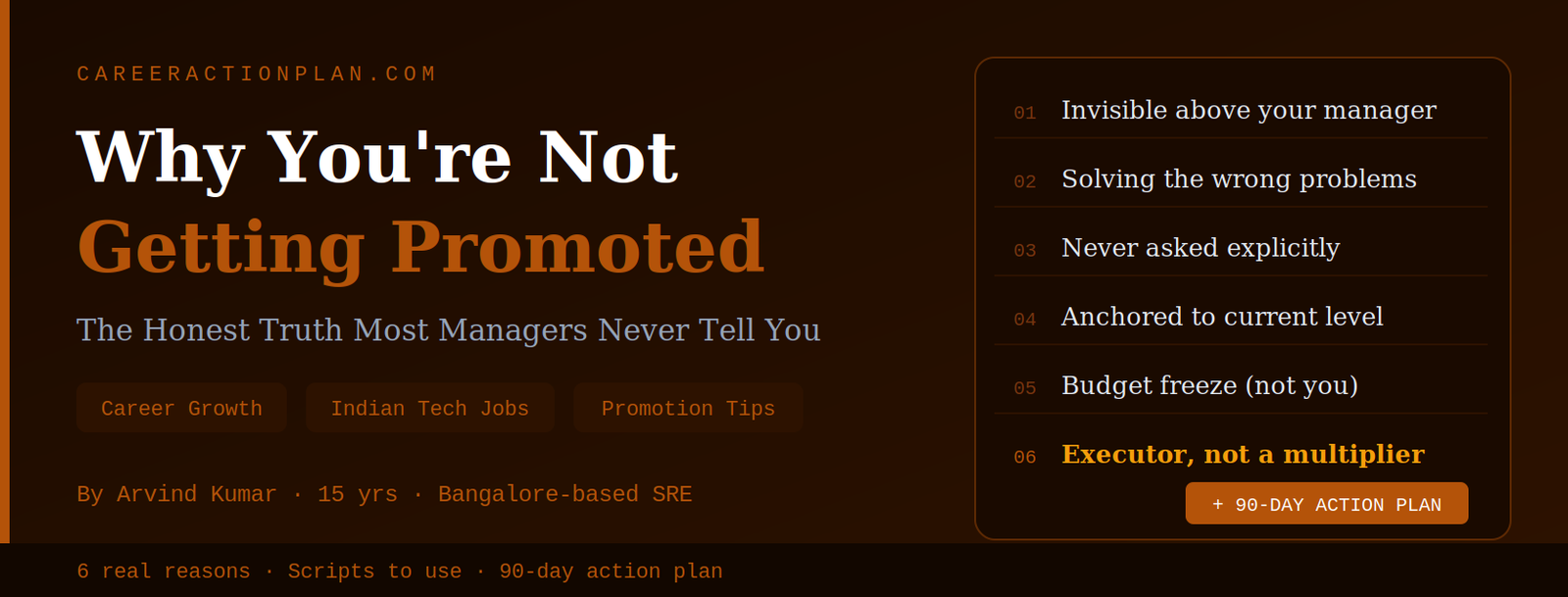
You're Invisible Above Your Manager
Your manager knows your work. Their manager doesn't. Promotions above a certain level require skip-level buy-in.
You're Solving the Wrong Problems
You're doing your job excellently. You're not working on what the business actually needs right now.
You Haven't Asked Clearly
Most engineers assume good work speaks for itself. It doesn't. Promotion conversations need to happen explicitly.
You're Perceived as the Current Level
If you've been an SDE-2 for 3 years, people mentally anchor you there. You have to actively shift the perception.
Budget or Headcount, Not You
Sometimes the reason why you are not getting promoted has nothing to do with your performance at all.
You're a Reliable Executor, Not a Leader
At senior levels, companies promote people who make systems and teams better — not just people who execute well.
Let me go deep on each of these.
Reason 1: You Are Not Getting Promoted Because You're Invisible Above Your Manager
This is the single most underappreciated reason why you are not getting promoted in large Indian tech companies and GCCs. Your direct manager controls your day-to-day feedback and your performance rating. But promotions — especially to senior and staff levels — require the manager's manager to agree. In many companies, they require a panel or calibration committee of three to five senior leaders.
If none of those people have ever heard your name in a positive context, your promotion pitch has an immediate credibility problem. Your manager is essentially asking a room of people to bet on someone they don't know.
How to Fix the Visibility Problem
You need deliberate skip-level visibility — not office politics, not sycophancy. Practical ways to build it:
Speak in all-hands and town halls. Ask a sharp, relevant question. Make a short observation about a cross-team dependency. Even 45 seconds of airtime in front of senior leadership changes your presence in the room.
Write internal posts or documentation that travels. An incident post-mortem written clearly enough that other teams share it internally is worth ten quiet execution victories. Engineering blogs, wiki pages, design docs with your name on them — these create an evidence trail that spreads beyond your immediate team.
Request a skip-level 1:1. Most engineers never do this. Ask your manager for permission, then ask your skip-level for 20 minutes once a quarter. Come with three specific contributions and one strategic question. It's not unusual — it's expected at senior levels. What's unusual is doing it before you reach senior level.
Reason 2: You Are Not Getting Promoted Because You're Solving the Wrong Problems
This is the one that's hardest to hear. You might be genuinely excellent at your job — technically sharp, reliable, thorough — and still be wondering why you are not getting promoted, because the work you're doing excellently is not the work the organisation needs to promote right now.
Every organisation has a small set of strategic priorities at any given time. In a startup, it's growth and retention metrics. In a GCC, it might be regulatory compliance, platform migration, or a global initiative the parent company is running. In IT services, it's client satisfaction on high-margin accounts.
Engineers who get promoted are visibly contributing to those priorities — not just their team's backlog. The ones who get passed over are often doing critical maintenance work that keeps the lights on, but isn't visible in the promotion narrative.
How to Align Your Work to What Actually Gets Promoted
Ask your manager directly: "What are the top three things leadership is focused on this half?" Then map at least one project you're working on to that list. If none of your current work maps, raise that explicitly — and ask to be considered for something that does.
Understand your company's promotion rubric. Most large companies have written level expectations. At Flipkart, Amazon GCC, Goldman Sachs, and most IT services firms, these documents exist and are accessible. If you haven't read yours, read it this week. The gap between where you are and what the next level requires is almost always more specific than "do more impactful work."
Reason 3: You Are Not Getting Promoted Because You Haven't Asked
I know this sounds obvious. But in 15 years of working in Indian tech, the single most common reason why you are not getting promoted that I've seen in peers and mentees is simply: they never explicitly asked.
There's a cultural pattern in Indian workplaces — particularly in services companies — where asking for a promotion feels presumptuous. Studies on workplace advocacy show that employees who explicitly ask for advancement are three times more likely to receive it within 12 months than those who wait to be recognised. You wait for the organisation to recognise you. You assume your manager is advocating behind the scenes. You believe that asking directly will come across as demanding or ungrateful.
None of that is true in any company I've worked at or worked with. What managers actually think when you ask: "Good. Now I know what to work toward with this person."
How to Have the Promotion Conversation
Don't ambush your manager in a weekly sync. Request a dedicated conversation. Something like:
In that conversation, come prepared with three things: evidence of what you've already delivered at the next level, a clear ask ("I'd like to be considered for SDE-3 / Senior Engineer / L6 in the next cycle"), and a genuine question about what gaps your manager sees. Then listen carefully. The answer to that last question is more valuable than anything else in the conversation.
If the answer is vague ("keep doing what you're doing"), push gently: "What would need to be true for you to feel confident making the case for me in calibration?" Specificity is what you're after. Vague feedback is not a green light — it's a delayed no.
For more on how to handle difficult career conversations — including offer negotiations that often follow a long-delayed promotion — the counter offer negotiation guide on this blog covers the framing and scripts in detail.
Reason 4: You Are Not Getting Promoted Because of How You're Perceived
Perception is not fair. But it is real, and understanding it is essential if you want to stop wondering why you are not getting promoted and start doing something about it.
If you've been at the same level for two or more years, people — including your manager and their peers — have mentally anchored you to that level. This is not conscious bias in most cases. It's a cognitive shortcut. "Rahul is our SDE-2 who handles the payments service." The moment that sentence gets repeated often enough, it becomes your identity in that organisation.
Promotion requires actively disrupting that anchor. You have to be seen operating at the next level before the promotion is given, not after.
What "Operating at the Next Level" Actually Means
This phrase gets used constantly in performance reviews and means different things at different companies. Here's a practical translation for Indian tech contexts:
| Current Level | What You're Doing Now | What the Next Level Looks Like |
|---|---|---|
| Junior / SDE-1 | Completing assigned tasks reliably | Owning a feature end-to-end, flagging dependencies proactively |
| Mid / SDE-2 | Owning a service or component | Driving cross-team technical decisions, mentoring juniors, writing design docs that others adopt |
| Senior / SDE-3 | Leading a team's technical direction | Influencing roadmap, raising the bar on engineering standards, making hiring decisions |
| Staff / Principal | Deep expertise in one domain | Cross-org technical leadership, shaping multi-quarter strategy, visible externally |
The engineers who get promoted quickly are not the ones who master their current level perfectly. They're the ones who start doing the job above them before anyone officially calls them that.
Reason 5: You Are Not Getting Promoted Because of Budget — Not Your Performance
Sometimes the reason why you are not getting promoted has absolutely nothing to do with you. Promotion budgets in most Indian tech companies and GCCs are allocated as a percentage of headcount — typically 10–20% of the team can be promoted in any given cycle. If your team has had three promotions in the last two cycles, you might be next in queue regardless of your relative performance.
IT services companies have additional constraints: client billing rates cap what they can pay certain grades, and promotion timelines are often linked to billability status rather than pure performance. A bench engineer, no matter how talented, rarely gets promoted.
This is also where understanding your external market value becomes critical. If you're overdue for promotion internally, check what the market is paying for your skills right now. The Bangalore tech salary guide for 2026 gives you the real benchmark numbers by role and experience level.
Reason 6: You Are Not Getting Promoted Because You're an Executor, Not a Multiplier
This is the one that bites senior engineers most often. Past a certain level — typically senior engineer and above — technical execution stops being the primary promotion criterion. The question shifts from "Can this person build things well?" to "Does this person make the people and systems around them better?"
If you are not getting promoted from senior to staff, or from lead to principal, this is almost certainly the reason. You are being assessed on a different dimension than the one you've been optimising for.
The Multiplier Behaviours That Actually Get Staff-Level Promotions
Technical mentorship with measurable outcomes. Not just "I help juniors when they ask." Actively running design reviews, setting up code standards the team adopts, tracking the growth of people you've mentored. When someone you've mentored ships something excellent, your name should be in that story.
Cross-team influence without authority. Did you get three teams to adopt a shared observability standard? Did you convince product to re-sequence a roadmap item because of a technical risk you surfaced? Influence without authority — getting things done across the organisation without using your title — is the defining staff-level competency. This is also directly relevant if you're weighing the SRE vs Platform Engineering career path, where this distinction becomes a core job requirement.
Writing that shapes decisions. Design documents, architecture proposals, post-mortems with systemic recommendations — the kind of writing where people change their plans after reading it. If your writing produces no downstream decisions, it's documentation. If it produces decisions, it's leadership.
The Deadly Mistake: Waiting Until You're "Ready"
Across all six reasons why you are not getting promoted, there's one meta-mistake that underlies most of them: waiting.
Waiting until you feel ready to ask. Waiting until the work speaks for itself. Waiting until your manager brings it up. Waiting for the right project to land in your lap. Waiting for the budget to open up without checking when that is. Waiting for someone to tell you what operating at the next level means.
According to research from Harvard Business Review, people who actively manage their promotion conversations — rather than waiting for recognition — advance significantly faster, even when controlling for performance. The effect is not small. The engineers I know who moved from SDE-2 to Staff in under six years all had one thing in common: they treated their career like a project they were managing, not a reward they were waiting for.
Promotion systems are not designed to surface talent automatically. They're designed to respond to evidence and advocacy. You have to generate both.
Why You Are Not Getting Promoted in IT Services vs Product vs GCC: Does It Differ?
Yes, significantly. The mechanics of why you are not getting promoted change depending on your company type — and if you're in the wrong environment for your career stage, no amount of individual effort will fix a structural problem.
IT Services: Promotions are heavily time-banded. Most large services firms have minimum tenure requirements — you cannot be promoted to Band C before 3 years at Band B, regardless of performance. The system is designed for predictability, not acceleration. If you're hitting this ceiling, the honest answer is that the fastest promotion path may be leaving. This is one of the core arguments in the IT services vs product vs GCC India comparison — the growth ceiling in services is structural, not personal.
Product Companies: Promotions are faster but less predictable. A strong half-year can get you promoted above your tenure. A reorg can delay you by two years. The key variable is manager quality and company growth stage. Growing companies create new senior roles; flat companies don't.
GCCs: Most GCCs follow the parent company's global band structure, which means promotion criteria are often well-documented, globally calibrated, and less subject to individual manager discretion. The process is more formal — you typically need a written case, peer feedback, and a panel — but it's also more transparent. If you're in a GCC and wondering why you are not getting promoted, ask HR for the level framework document. It almost certainly exists.
Your 90-Day Action Plan If You Are Not Getting Promoted
If you've read this far and recognise yourself in two or more of the reasons above, here's a concrete plan. Not motivational advice — an actual sequence of actions.
Week 1–2: Diagnose honestly. Read your company's level expectations for the next grade. Write down three pieces of evidence that you're already operating at that level. If you can't write three, that's your answer — you have a performance gap, not a visibility gap.
Week 3–4: Have the explicit conversation. Request a dedicated 1:1 with your manager. State your intent clearly. Ask what gaps they see. Ask what the calibration process looks like and when it happens next. Get specifics in writing if possible — a follow-up email summarising what was discussed is perfectly professional.
Month 2: Build your visibility deliberately. Identify one cross-team project or initiative you can contribute to this quarter. Speak once in a forum where your skip-level is present. Write one internal document that travels beyond your team.
Month 3: Reassess and decide. If your manager gives you a clear roadmap and you're making progress — great, continue. If the feedback is still vague, the budget is frozen indefinitely, or the goalposts keep moving — that's data. The job market in 2026 is competitive but not closed. Sometimes the fastest path to the promotion you deserve is demonstrating at interview that the market agrees with your self-assessment. Check what questions to prepare with the interviewer question guide when that time comes.
Quick Reference — Why You Are Not Getting Promoted
- Invisible above your manager? → Request skip-level 1:1s, write internal posts, speak in all-hands
- Solving the wrong problems? → Map your work to leadership's top 3 priorities this half
- Never asked explicitly? → Request a dedicated promotion conversation this week
- Anchored to current level? → Start doing the job above you before you have the title
- Budget freeze? → Confirm the timeline, check your external market value
- Executor vs multiplier? → Mentor formally, influence cross-team, write docs that change decisions
- In IT services with a tenure ceiling? → The fastest promotion may be an external move. See IT services vs product vs GCC India
- Salary benchmark: Know your market value before any negotiation → Bangalore tech salary guide 2026
The uncomfortable truth about why you are not getting promoted is that the system is not broken — it's just not automatic. It responds to evidence, advocacy, and timing. All three are things you can influence. Start this week.