We've sent hundreds of applications in the last few months. LinkedIn keeps showing "recruiter viewed your profile" almost daily. And our phones stay silent. If we're wondering why recruiters aren't calling back despite doing everything the advice videos told us to do — this post is going to make us all uncomfortable before it makes us useful.
I get some version of this question in DMs at least three times a week. Engineers with 4 years, 8 years, 12 years of experience. Product companies, GCCs, IT services — the pattern is the same. Applications go out. Nothing comes back. And the natural instinct is to send more applications.
That is exactly the wrong move.
After looking at maybe forty of these cases in the last year — and after fixing my own LinkedIn profile very publicly over the last 18 months — I can say this with some confidence: why recruiters aren't calling back has almost nothing to do with how many jobs we applied to. It has everything to do with how we show up when a recruiter actually searches for someone like us. Most of us in Indian tech are invisible in the exact moment when it matters, and we don't know it.
What This Post Covers
- The actual reason why recruiters aren't calling back — and it's not our resumes
- How a recruiter's LinkedIn search works, and why 90% of profiles never surface
- My own LinkedIn journey — what I fixed, how, and what changed
- A 3-question diagnostic to test whether we're invisible right now
- The 5 LinkedIn profile elements that determine whether recruiters can find us
- Real before/after examples from Bangalore, Hyderabad, and Pune engineers
- A 5-hour weekend action plan to fix everything, in order
The Uncomfortable Truth About Why Recruiters Aren't Calling Back
Here is the part nobody wants to hear.
The job market in India in 2026 is not bad. It's selective. GCCs are still hiring aggressively — NASSCOM's industry reports keep confirming double-digit growth in Global Capability Centres. Product companies are hiring. Even IT services are hiring at senior levels. Which means when someone tells me "there are no jobs," I already know what's actually happening.
There are jobs. There are recruiters. There are open roles that match our profiles almost perfectly. The problem is that we're not the people they see when they run their search.
Applications are a broken channel. Every popular job posting on LinkedIn or Naukri gets 500 to 2,000 applicants within 48 hours. Nobody reads them one by one. An ATS filters most of them out, and a recruiter spot-checks the top 15. If our resume is application number 847, it doesn't exist.
The channel that actually works is the reverse channel — the recruiter finding us. And this is where we find out why recruiters aren't calling back: they cannot find us.
How Recruiters Actually Search on LinkedIn
Let me walk through what a recruiter does in a normal working day, because once we see it, everything about our LinkedIn profiles changes.
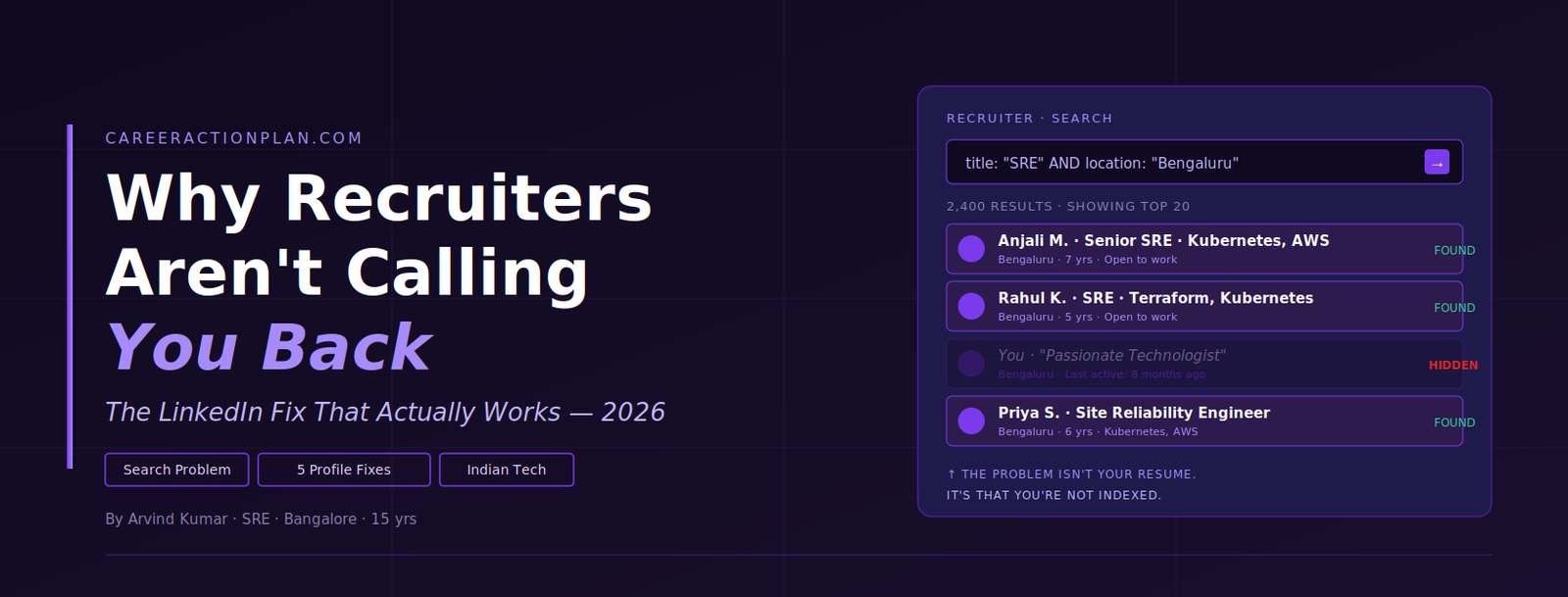
A recruiter at a Bangalore GCC opens LinkedIn Recruiter — the paid version, not the one we use — and pastes in a search string. Something like:
title: "site reliability engineer" AND location: "Bengaluru" AND skills: "Kubernetes" AND experience: "5-8 years"
The system returns maybe 2,400 profiles. She sorts by "most relevant." She looks at the top 20. Of those, she messages 8. Of those 8, maybe 3 reply. Of those 3, maybe 1 goes to phone screen.
Read that again. She looked at 20 profiles out of 2,400. To make it into that top 20, our profile has to match her exact keywords in the exact fields LinkedIn indexes for search. That's the entire game.
This is the single biggest reason why recruiters aren't calling back. It's not that we're not good enough. It's that LinkedIn's ranking algorithm doesn't know we exist for the searches that matter. The LinkedIn Talent Solutions blog is fairly transparent about the fact that keyword match, activity level, and profile completeness are the three big signals. Most of us in Indian tech score badly on all three.
What I Fixed On My Own LinkedIn — And Why I'm Still Iterating
Before we go further, I want to be honest about something. Everything in this post, I learned by fixing my own profile first. Slowly. Badly at first. Over the last 18 months.
For most of my 15-year career, my LinkedIn was exactly the kind of profile I'm now telling us all not to have. My headline said something like "Site Reliability Engineer | Passionate about distributed systems and clean architecture." My About section was two paragraphs of feel-good sentences about "loving the craft" and "learning always." My Skills list had 40 skills nobody looked at, and the top 3 — the ones that actually matter for search ranking — were auto-populated with things I hadn't touched in years. I hadn't posted in maybe two years. Not a single update, not a comment on anyone else's work.
The result was predictable. Almost no recruiter InMails. Occasional views from people who already knew me. Complete invisibility to the recruiter searches actually happening for SRE roles in Bangalore.
The Moment It Clicked
After my layoff in September 2024, I sat with that profile open and finally saw it for what it was — a page that told my story but told the algorithm nothing. I had spent a decade doing serious infrastructure work and my LinkedIn read like a college project write-up.
So I did what most of us do now. I watched career-strategy videos on YouTube — the good ones and, honestly, some very bad ones too. I read LinkedIn's own creator playbooks. I lurked in the profile-review threads on Reddit. And I leaned heavily on ChatGPT and Claude — not to write anything for me, but to push back on my drafts. I'd paste in a headline and ask "what strings would a Bangalore GCC recruiter search for that this doesn't contain?" I'd rewrite my About section and ask "which sentences here are just filler?" It became a slow, honest editing loop.
I'm still doing this. Every three months or so I go back and refine — a new project I finished, a new tool I picked up, a different way to phrase what I actually do. The last 18 months have been continuous small edits, not one dramatic overhaul. Most of what I know about visibility, I learned from my own profile failing to surface and then figuring out why.
And the result — even though I'm not actively looking for a job right now — is one to two calls a week from recruiters at real companies. Not spam. Not "we have an urgent requirement for Java developer" mass DMs. Real conversations with GCC recruiters, product-company hiring managers, and the occasional founder. This is what visibility feels like when it works. The calls come in whether we want them or not. That's the state we're aiming for — because it removes the panic from job search entirely. When we do want to move, the reverse channel is already warm.
The 3-Question LinkedIn Invisibility Test
Before we fix anything, let's diagnose. Open LinkedIn on another tab and honestly answer these three questions. If we fail any one of them, that's a strong signal for why recruiters aren't calling back in our case.
1Does our headline contain the exact job title we want next?
Not our current title. The title we want to be searched for. If we're an SDE-2 at a service company aiming for a product-company role, our headline should say "Software Engineer" — because that's the string recruiters search. "Passionate technologist" and "Turning coffee into code" are jokes. Recruiters don't search for those.
2Are our top 3 skills the exact skills in the job descriptions we want?
Open five job postings we'd love to get. Note the top skills each one lists. Are those the same skills sitting at the top of our LinkedIn Skills section? If not, we're not indexed for those searches. Skills are a heavily-weighted ranking signal.
3Have we posted or commented on LinkedIn in the last 14 days?
Activity level is a ranking factor. A profile that has been dormant for 8 months ranks lower than an equally-qualified profile that posted a thoughtful comment yesterday. Doesn't have to be viral content. Even 3 real comments a week is enough to signal "active."
If we failed 2 or 3 of these questions, we now know why recruiters aren't calling back. Good news: every one of these is fixable in a weekend.
Why Recruiters Aren't Calling Back: The 5 Profile Elements Killing Visibility
Here are the five profile elements that decide whether we appear in a recruiter search. Fix these in order. Don't skip any.
1. Headline — The Single Most Important Line
The headline is the one field LinkedIn weighs heaviest in search. It also appears next to our name in every DM, every InMail, every comment. It works twice — once for the algorithm, once for the human.
Before
Passionate about building scalable systems | Ex-Infosys | IIT Roorkee | Coffee lover
After
Senior Site Reliability Engineer | Kubernetes, AWS, Terraform | 8 years | Bengaluru | Open to product/GCC roles
The "after" version is not clever. That's the point. It's a list of exactly the strings a recruiter types into search. Job title, top skills, years of experience, location, and a signal of what we're open to. The "before" version is invisible for every one of those searches.
2. About Section — Written For Skimming, Not Reading
The About section is the second-most-indexed field. Most of us treat it as a philosophy statement. Recruiters treat it as a keyword field they skim in 8 seconds.
Write it in four short paragraphs:
- Paragraph 1: One line stating what we do now, with our target job title as the noun.
- Paragraph 2: Three concrete achievements with numbers. "Reduced deployment time from 45 minutes to 4 minutes." Not adjectives. Numbers.
- Paragraph 3: Technical stack as a comma-separated list. All our searchable skills in one place. Boring is good here.
- Paragraph 4: One line on what we're looking for next, so a recruiter reading it knows immediately whether to reach out.
3. Skills Section — The Top 3 Rule
LinkedIn lets us list up to 50 skills. Only the top 3 matter for ranking. Those top 3 are shown as our "top skills" and they get weighted heavily in search.
Go to Skills right now. Look at the top 3. Are they the exact skills we want to be found for, or are they whatever LinkedIn happened to auto-populate three years ago? Reorder them. This takes 90 seconds and it's the single highest-leverage 90 seconds we'll spend this weekend.
4. "Open To Work" Settings — Private Mode Only
Turn on "Open to Work" but set it to Recruiters Only, not the public green ring. The green ring signals distress and hurts us in negotiations later. Recruiters Only tells LinkedIn's algorithm to boost our profile in search results for recruiters at companies that fit our criteria, without broadcasting anything to our current employer.
In the Open To Work panel, fill in every field carefully:
- Target job titles — put the top 3, not just one
- Locations — include Bengaluru, Hyderabad, Pune, and Remote if we're open to it
- Start date — "Immediately"
- Job types — Full-time (add Contract if we're open to it)
5. Experience Descriptions — Keywords, Not Prose
Every job on our Experience list should have 4 to 6 bullet points. Each bullet should contain at least one hard skill or tool. Recruiters searching for "Kafka" don't want to read our paragraph about "leading cross-functional collaboration." They want to see "Kafka" appear in the context of what we actually built with it.
Rewrite each Experience entry in this format:
[Action verb] + [system/tool] + [measurable outcome]
Example: "Migrated 40 microservices from EC2 to EKS, reducing infrastructure cost by 32% and cutting deployment time from 20 minutes to 4 minutes." That single line hits four searchable keywords and shows scale. Now imagine 6 of those per role, and 3 roles listed. Suddenly we're indexed for 60+ terms instead of 6.
Real Before/After Examples From Indian Tech Professionals
I want to share three anonymised examples from engineers I've worked with in the last few months. Names changed. Situations real.
Case 1 — Vishwajeet, DevOps Engineer, Pune, 6 Years
Vishwajeet sent 340 applications over 5 months. 4 callbacks. All rejections. When we looked at his LinkedIn, his headline was "DevOps Enthusiast | Ex-TCS | Learning always." His top 3 skills were "Teamwork," "Communication," and "Problem Solving." His last post was from 2023.
We changed the headline to "DevOps Engineer | Kubernetes, GitLab CI, Terraform, AWS | 6 years | Pune | Open to product/GCC roles." Reordered skills to Kubernetes, Terraform, AWS. Rewrote three experience entries with numbered outcomes. Told him to comment on 3 posts a week from CTOs and hiring managers in his target companies.
Within 6 weeks he had 11 recruiter InMails. Signed with a GCC in Pune at a 42% hike. He didn't send a single new application in that window.
Case 2 — Priyanka, Data Engineer, Bangalore, 4 Years
Priyanka's problem was the opposite. Her profile was fine on keywords. But she had zero activity — she'd never posted, rarely commented. She was applying to 5 jobs a day and hearing nothing.
We didn't touch her profile. We changed one thing: she committed to commenting on 3 posts a day from senior data leaders at her target companies, using genuine technical opinions, not "great post!" filler. That's it.
Three weeks in, one of those senior leaders looked at her profile, saw the match, and referred her internally to a data platform team. Offer in 5 weeks. This is what activity does. The algorithm rewards it, and so do the humans.
Case 3 — Vanitha, Software Engineer, Hyderabad, 11 Years
Vanitha's issue was seniority-mismatch. Her headline read "Software Engineer" but she was targeting Staff Engineer roles. Recruiters searching for Staff-level candidates were filtering her out. She was applying to Staff-level roles cold and getting rejected at resume-screen.
We changed her headline to "Software Engineer aiming for Staff | Distributed Systems, Java, AWS | 11 years | Hyderabad." Note the "aiming for Staff" — it's not a title claim, but it registers the intent. We also rewrote her About section to lead with distributed systems architecture work, not general SDE work.
She had 6 Staff-level conversations within 8 weeks. She's currently negotiating an offer. The unlock wasn't a new skill. It was becoming findable for the level she was already operating at.
The 90-Day Trajectory: What Changes When We Fix This
If we fix these 5 elements this weekend and stay consistent on activity for 3 months, here is a realistic trajectory. This is based on what I've watched happen dozens of times — including on my own profile — not hype.
| Week | What We'll See | What To Do |
|---|---|---|
| Week 1 | Profile views up 3-5x. Search appearances up. | Don't celebrate. Keep commenting. |
| Week 2-3 | First 1-2 recruiter InMails, usually low quality. | Reply politely to all. It trains the algorithm. |
| Week 4-6 | Better recruiter InMails. Some from target companies. | Take screening calls even if unsure — practice. |
| Week 7-9 | First real interview loops from strong companies. | Prep systematically. Don't wing it. |
| Week 10-12 | First offer or close to it. | Negotiate hard. We have leverage now. |
This trajectory only works if we keep the profile updated and stay active. Fixing the profile once and disappearing for 6 months resets us to invisible. The visibility signal decays. Keep it warm.
The 5-Hour Weekend Action Plan
Here is the exact plan. Block 5 hours this weekend. Don't spread it out — the momentum matters.
Hour 1: Research (Do Not Skip This)
Open 5 job postings we'd genuinely take if offered tomorrow. Different companies, same level, same function. From each posting, list:
- The exact job title
- Top 5 skills mentioned
- Any tools mentioned by brand name
- The level (SDE-2, Staff, Principal, etc.)
Now consolidate: what's the most common job title? What are the 5 skills that showed up most? Those are the strings we're optimising for. Everything downstream flows from this list.
Hour 2: Headline + About
Rewrite the headline in the format from Section 1 above. Rewrite the About section as 4 paragraphs. Both should now contain the exact strings from the research list. This is exactly the step where I personally use ChatGPT and Claude the most — pasting in a draft and asking what keywords are missing, or which sentences read like filler. The tools don't write the profile. They stress-test it.
Hour 3: Skills + Experience
Reorder Skills so the top 3 match target roles. Delete any skill that's off-brand (yes, that "Microsoft Word" skill from 2018 is hurting us). Rewrite the last 3 job entries in the [verb] + [tool] + [outcome] format, 4 to 6 bullets each.
Hour 4: Open To Work + Photo + Banner
Turn on Open To Work → Recruiters Only. Fill every field. Update the photo if it's older than 3 years — a decent, well-lit headshot beats a professional shoot with bad lighting. Add a banner image that shows a relevant tech scene (many free ones on Unsplash). A blank grey banner signals a dormant profile.
Hour 5: Set Up the Activity Habit
Follow 30 people at target companies — CTOs, VPs of Engineering, senior ICs. Not recruiters. The people whose posts recruiters see. Now commit to this: 3 comments per week, minimum, for 90 days. Real comments. Technical opinions. Push-backs. Agreements with reasoning.
Put a recurring calendar block on Tuesday and Friday mornings. 15 minutes each. That's the entire activity budget. This is what most of us won't do — which is exactly why doing it works.
What We Should Not Do
A few things I want to warn against, because I see people do them and it wastes months.
Where To Go From Here
If this is landing, three follow-up posts to read next:
- How to Get Into a GCC in India in 2026 — because once we fix visibility, GCCs are where most of the good roles are hiding right now
- IT Services vs Product vs GCC India — An Honest Comparison — helps us pick the target profile we're actually optimising for
- Why You Are Not Getting Promoted — if we're not looking to switch but the callbacks issue is really a promotion issue in disguise
And if we want to see how these visibility fixes translate into salary numbers when the calls finally come, the Naukri JobSpeak Index is a decent public reference for what's actually happening in Indian hiring right now.
The One Line To Remember
Why recruiters aren't calling back is almost never a resume problem. It's a search problem. Fix the five profile elements above, stay active for 90 days, and stop treating applications as our primary channel. The reverse channel — recruiters finding us — is where 70% of good Indian tech offers come from in 2026. Get in that channel. I'm in it, and it's changed how job search feels entirely.