

If you're reading this, one of a few things is probably true. You just got laid off. Or you're three weeks in and still haven't gotten a single callback. Or you're four months deep and starting to doubt whether you'll ever work again.
This layoff recovery guide India is written for exactly that moment. Not from theory — from someone who lived through it.
I've been there. September 2024. Thirteen years and eight months in Indian tech, most of it in DevOps and SRE. I did not see it coming.
Since I shared that story on LinkedIn last week — and it reached nearly 200,000 people — my inbox has been full of the same question, phrased in different ways: "I'm going through this right now. What do I actually do?"
This is my answer. Not the sanitized LinkedIn version. The real one — what to do emotionally, financially, and practically over the next 45 days.
I'm going to walk you through what I actually did, what worked, what didn't, where I struggled, and where I got lucky. Most importantly, I'm going to tell you what you should do right now, today, before you close this tab.
WHAT THIS 45-DAY LAYOFF RECOVERY GUIDE INDIA COVERS
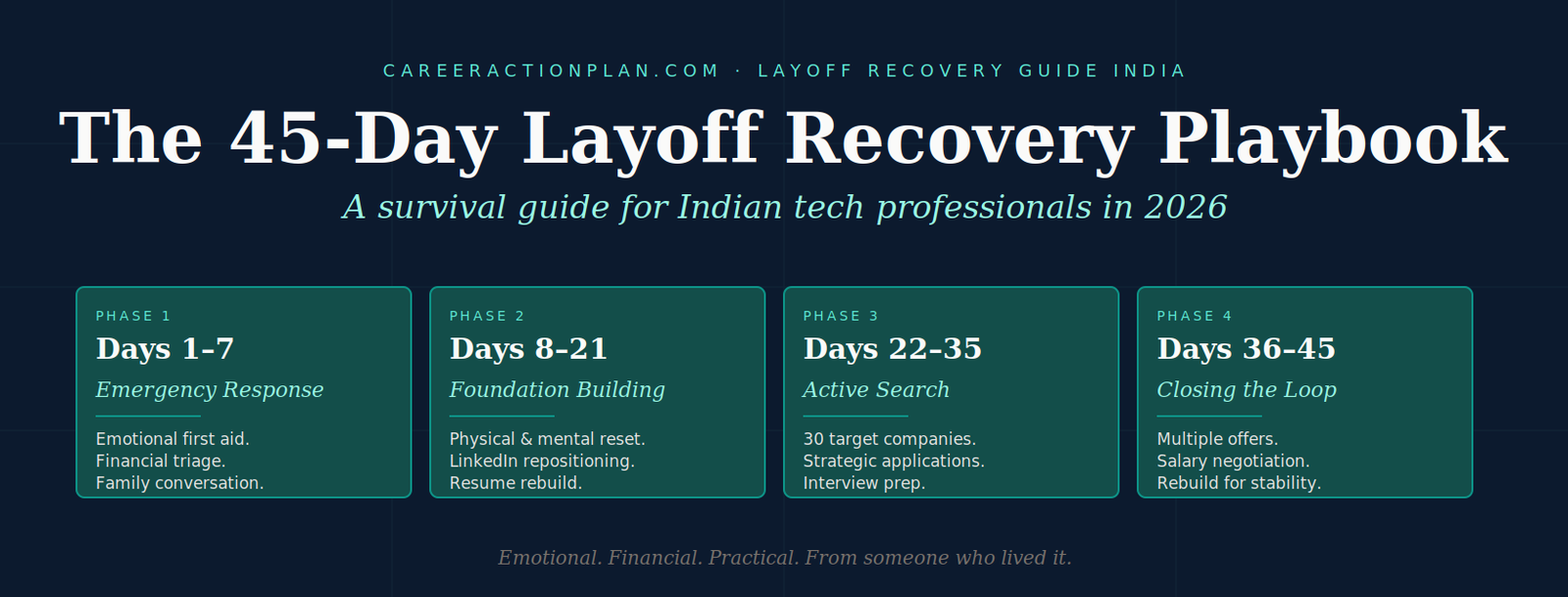
- Days 1–7: Emergency response — emotional first aid, family conversations, and the financial triage that decides everything
- Days 8–21: Foundation — physical and mental reset, then repositioning across LinkedIn, résumé, and GitHub
- Days 22–35: Active search — skills-mapped target companies, strategic applications, interview prep, and coding-round reality
- Days 36–45: Landing — the Learning/Application/Re-assessing/Interview cycle, held with patience until you sign
- Plus emotional survival, Indian family dynamics, and honest stories about what actually works — from someone who lived it
One honest note before we start — this layoff recovery guide India is long. Longer than most blog posts you'll read. That's intentional. A 500-word "5 things to do after a layoff" post is fine for LinkedIn scroll — but it's not going to help you through 45 real days when your world has just come apart. Skim to the sections you need today. Bookmark the rest. Come back when you're ready.
5 Hard Truths Every Layoff Recovery Guide India Skips
Before the framework, five hard truths. I wish someone had told me these on Day 1. They would have saved me two weeks of unnecessary suffering — and no layoff recovery guide India I found online at the time said any of them plainly.
1. Layoffs in Indian tech are systemic now, not personal
TCS is reducing 24,000+ mid-senior roles in FY26. Infosys, Wipro, Capgemini, and Cognizant have all had significant workforce corrections. Product companies aren't spared either — Meta India, Google India, Amazon, and Microsoft India have all had rounds. According to NASSCOM's 2025 strategic review, the workforce mix is shifting fast, and mid-senior technical roles are the ones being restructured.
This is not a reflection of your worth. If you were let go, it's because a business model changed, a client contract ended, a team was reorganized, or an executive decision was made in a room you were never in. It is almost never because you're not good enough.
2. The first 10 days will be brutal
Nobody warns you about the physical part. Sleep gets weird. Appetite goes up or vanishes entirely. You'll cycle through shock, denial, anger, and fear — sometimes all four in the same afternoon. You'll withdraw from social contact. You might not want to look at your phone.
All of this is normal. It's your nervous system processing a major disruption. It will pass. But you have to let it happen instead of fighting it or forcing yourself into "productive job search mode" from Day 1. That's the biggest mistake I see people make.
3. Your identity will feel shaken
For years, when someone asked "what do you do?" you had an easy answer: Senior Engineer at X. That was your identity in every social setting, family conversation, WhatsApp group. Now the answer is uncomfortable. That crisis is real. We'll address it explicitly later in this guide.
4. Money pressure will be worse than expected
Even with severance in the bank, the anxiety is real. Fixed costs continue — EMIs, rent, groceries, school fees, aging parents' medical bills. Dependents multiply the pressure. Cultural expectations add weight most Western guides never account for.
5. Well-meaning advice will hurt
"Just apply more." "Have you tried LinkedIn?" "You'll find something." "Have you talked to X?" People will offer these with love, but most have never been through a real senior-level tech layoff in the current market. Their advice is 2015 advice. Your reality is 2026.
Phase 1: Days 1–7 (The Toughest Phase)
Every layoff recovery guide India publishes rushes past this week — but this is the hardest week. Not just of the recovery — often of your entire career until now. Shock. Anger. Denial. A slow, reluctant acceptance. All four will hit, sometimes on the same day. Give this phase the time it needs. Don't rush it. Trying to skip past it directly into "job search mode" is the single biggest mistake I see, and I made it too.
The first week is not about finding a job. It's about not making things worse.
Accept it. Stabilize. Don't strategize yet.
Let the shock move through you. The nervous system needs to reset. The money needs to be counted. The family needs to be brought in. Everything else waits.
Days 1–3: Emotional First Aid
Day 1: The Announcement
You've been told. Whatever the format — a Zoom call, a manager's cabin, an HR email — the shock is the same. Before you leave the building (or close the laptop), get the exact terms in writing. This is the single most important thing you'll do all week.
Ask for clarity on:
- Last working day (LWD)
- Notice period — are they paying it out, or do you serve it?
- Severance — how many months, when it will be paid, whether it's taxable
- Insurance continuation — how long does your health cover extend?
- Non-compete clauses — what restrictions apply, and for how long?
- What you can retain — laptop, learning credits, any personal projects
- Reference commitment from your manager — get this in writing today
- Unused leave encashment
- Any bonus you're eligible for that hasn't been paid
If HR won't give you specifics on the spot, ask them to send it in email within 48 hours. Do not sign anything final until you have every number.
Day 2: The Family Conversation
Tell your spouse first, in private, without the kids around. Not over WhatsApp. Face to face.
Here's the part nobody tells you — it's going to be hard to talk normal. You may feel ashamed, even in front of the person who has known you for years. That shame is not real, but it will feel very real in that moment. Just let it be. Tell them the story. What happened. When. What HR said. What you're worried about.
And if you want to cry — cry. For a moment. We are human. Ten years of being "the strong one" doesn't disqualify you from being human on the day your career takes a hit. Your spouse doesn't need a general — they need a partner. Let them see you.
Then say it simply: "It's not because of my performance. I have [X] months of runway. We'll get through this together." Even if you don't fully have a plan yet, saying "we'll get through this" changes the emotional frame from crisis to challenge.
The fewer people who know in Week 1, the fewer opinions you have to manage while your nervous system is still reeling. Decide together what to tell the kids (if any), what to tell parents (if dependent on you), and what to tell nobody at all yet.
I told my wife the same evening. Just her. That night I couldn't sleep properly, and neither could she — but at least we were in it together, not one of us pretending things were normal.
Then I waited two full days before telling anyone else. My younger brother was the second person to know. Not my parents. Not friends. Not even close cousins. Just my brother — because he's practical, wouldn't panic, and could be a second sounding board for money decisions if I needed one.
Everyone else — parents, extended family, wider circle — I told much later, once I had my footing back. That was intentional. In Week 1, your job is to protect your energy, not to update the community.
Day 3: One Trusted Peer
Pick one professional friend to tell. Not the whole industry. One person. And pick someone who has been through a layoff themselves — not the "have you tried applying to Google?" friend.
You're not asking them for a job. You're asking them to listen. That's it. Ninety minutes of being understood by someone who's walked the same road will do more for you than 500 job applications this week.
Days 4–7: Financial Assessment
By day 4, the initial shock has softened just enough that you can look at numbers without panicking. Don't skip this. The single biggest source of stress over the next 45 days will not be the job search — it will be money uncertainty. Get on top of it now.
Day 4: Fixed Cost Audit
Open a spreadsheet. List every rupee that leaves your bank account in a normal month. Not what you think you spend — what your statements actually show. Pull the last three months and average them.
Categorize each line: Essential (rent, EMIs, utilities, groceries, insurance, school fees), Important (transport, phone, medical), Cuttable (subscriptions, eating out, entertainment, discretionary shopping).
Day 5: Runway Calculation
Add up your accessible cash — savings account, fixed deposits you can break, liquid funds. Do not include your PF, gratuity (until it's actually paid out), long-term investments, or emergency reserves you promised yourself you wouldn't touch.
Divide accessible cash by monthly burn. That's your runway in months. If it's less than six months, we're in aggressive mode from Day 8 onward. If it's six to twelve months, you have breathing room. Either way, you now know the truth.
Day 6: Financial Triage — The Smart Approach
Don't rush to ask the bank for an EMI hold. That's the reflex, but it's not the first step. Here's the smarter sequence.
First, list every EMI on one sheet. Home loan, car loan, personal loans, any BNPL. For each one, note the monthly amount, the outstanding balance, and how many EMIs you can comfortably pay from your accessible cash without touching emergency reserves.
Then talk to your bank — but with numbers, not panic. Approach it like a professional: "I've had a role change. Right now I can comfortably service EMIs for the next [say, 2 months]. I'd like to discuss options if the transition takes longer." This is a completely different conversation from "please pause my EMIs." One protects your CIBIL. The other flags you as distressed.
You don't need to hamper your CIBIL score in the first month. Keep paying on time from your runway. Only escalate to formal moratorium or restructuring if the search extends past your buffer. Every month of on-time payments preserves the credit score you'll need for future financial flexibility.
Stop credit card spending completely. Not reduce — stop. Move your credit cards out of your wallet, out of your phone, out of the food delivery apps. Interest compounds against you the fastest of any debt in India. To search for a job effectively, you need financial peace of mind. Every credit card swipe in Week 1 is a small chip out of that peace.
Everything else: Cancel subscriptions you don't use daily. Downgrade the ones you do. Talk to your kids' school about fee flexibility — many private schools have quiet arrangements for parents in transition. Do NOT stop paying health or term insurance premiums. Those are non-negotiable.
Day 7: The Family Money Conversation
Sit down with your spouse — and if you're single or living with family, with whoever shares the financial reality with you. Bring the actual numbers. Not vague reassurance. Runway in months. Cost cuts you've both agreed to. The plan.
Frame it clearly at the start: "I'm not telling you this to scare you. I'm telling you so we're aligned on securing the coming days until I land the next role. That could be 45 days, could be 60. Let's plan for 60."
That framing matters. You're not announcing disaster — you're announcing a plan with a defined horizon. That's a very different conversation for your spouse to hear.
If you have a proper emergency fund plus your severance, you're in a strong position. Really strong. Enjoy that quiet confidence — it's the reward for years of financial discipline.
But let's be honest — in our country, maybe 1% of professionals have actually built a real emergency fund by the time a layoff hits. Most of us have some savings, some FDs, ongoing SIPs, and a lot of paper wealth locked in illiquid assets. If that's you, don't feel embarrassed. It's the norm, not the exception. What matters is what you do from today with what you actually have.
Set two checkpoints together: end of Month 2, end of Month 4. What happens if you're still searching at each mark? Talking about the "what if" now takes 80% of its power away.
Here's what a real fixed-cost audit looked like for one engineer I spoke to last week — Bangalore-based, one spouse working, two kids in school:
| Expense | Before | After Triage | Notes |
|---|---|---|---|
| Home EMI | ₹42,000 | ₹42,000 | Requested 3-month moratorium, decision pending |
| Car EMI | ₹18,000 | ₹18,000 | Considering sale in month 4 if needed |
| Groceries | ₹18,000 | ₹13,000 | Cooked at home, no meat weekdays |
| School fees | ₹25,000 | ₹22,000 | Requested quarterly instead of monthly |
| Utilities | ₹5,500 | ₹5,000 | Minor AC discipline |
| Health insurance | ₹9,000 | ₹9,000 | Non-negotiable |
| Subscriptions | ₹4,500 | ₹800 | Kept only what family uses weekly |
| Eating out | ₹10,000 | ₹2,000 | Two family meals a month, no more |
| Domestic help | ₹8,000 | ₹4,000 | Reduced days, spouse and I picked up slack |
| Total | ₹1,40,000 | ₹1,15,800 | ~17% reduction, no lifestyle destruction |
Notice: no drastic cuts. No selling the house. No pulling kids out of school. Just a 17% reduction that bought this family two additional months of runway from the same corpus. That's what a proper Day 4–7 audit does.
Phase 2: Days 8–21 (Foundation Building)
Recover the body. Reposition the profile.
Two weeks. First half rebuilds you physically and mentally. Second half rebuilds you professionally on LinkedIn and paper.
Days 8–14: Reset the Body, Prepare the Mind
Since childhood we've heard the line — a healthy body contains a healthy mind. Most of us treat it as an idle proverb. This is the phase where you implement it, seriously, for the first time.
Here's why. From now, you are going to use your mind at maximum — a level of focus, memory, and quick thinking most of us haven't demanded of ourselves in years. Preparing for interviews, revising fundamentals, learning new tools, negotiating offers — all of it needs a sharp brain. And a sharp brain doesn't come from a depleted body.
The daily anchors that matter
Sleep — 6 to 7 hours
It's hard right now. The mind will race at night. But try. Consistent sleep is the single biggest lever on your mental sharpness two weeks from now. Bed by 10:30 PM. No LinkedIn after 9 PM. No job boards in bed. That one rule alone will save your sleep, and your sleep will save your search.
Morning — a brisk walk
If you can't manage a full workout or meditation, that's fine. Just a brisk walk to the park near your home. Keep your earpods and a playlist ready — songs that lift you, not sad ones you'll spiral to. Twenty to thirty minutes. Feet moving, sunlight on your face, breath deepening. That's the reset.
Food — don't skip in panic
A healthy body needs fuel. When stress hits, many of us stop eating properly — either forgetting meals or grazing on snacks all day. Don't do that. If your appetite is low, that's okay — reduce to two proper meals instead of three, rather than skipping to zero. Real food. Home-cooked wherever possible. Your brain literally runs on what you eat.
Evening — a second brisk walk
Fifteen to twenty minutes, ideally after 5 PM. This one has a dual purpose. It resets your body from a day at the desk. And walks are the best time to mentally revise your core competency — the fundamentals of your domain, the topics you'll need for interviews. Your brain retains better when the body is moving gently. No notebook needed. Just think.
Meditation — five minutes is enough
Not an hour. Not perfect posture. Five minutes, once a day, sitting quietly, watching your breath. Use an app if you need one (Waking Up, Calm, Insight Timer — all have free tiers). If your mind wanders — and it will, constantly — that's the practice. Bringing it back. Five minutes. Every day.
Back to basics — the B2B principle
Alongside the physical reset, start a parallel track: Back to Basics. Whatever your core competency is — DevOps, backend engineering, data platforms, ML, distributed systems, cloud architecture, whatever — start looking at it from the base again. Irrespective of your experience level.
Fifteen years in the industry doesn't exempt you from this. In fact, senior interviews test fundamentals harder than you'd expect. Interviewers assume you know the advanced stuff — what surprises them is when a Staff-level candidate can't explain a basic concept crisply. Refresh from the ground up. First principles. The way you'd teach it to someone brand new.
Two parallel modes work well. Gentle revision on your evening walks — thinking through concepts, articulating them silently, testing whether you can explain them cleanly. And intensive hands-on study at your desk. Both matter, and neither replaces the other.
The desk time is where the intensity has to be. Casual reading won't cut it now. You need active, hands-on revision — because a good interviewer can drill three layers deeper than you expected, at any moment. That kind of readiness takes intentional practice, not scrolling engineering blogs.
If your budget allows, my honest recommendation is to take a KodeKloud subscription for this period. What made it worth every rupee for me — everything is in one place. And the killer feature is what it saves you: no hours wasted setting up hands-on environments. Kubernetes clusters, Terraform sandboxes, Docker playgrounds, AWS/GCP/Azure practice labs — all pre-configured, ready to run in a browser. In a normal working week that's a nice-to-have. When you're searching against a clock, it's a real accelerator.
Two investments I made in that transition period were both worth it — Naukri's paid résumé and profile service (which I mentioned earlier) and KodeKloud. Between them, a few thousand rupees. They accelerated the two things that mattered most: getting recruiter calls, and being sharp enough to convert them into offers.
If either had been a bad bet, I'd say so. Neither was.
If KodeKloud doesn't fit your domain — it leans heavily toward DevOps, SRE, Cloud, and Kubernetes — Udemy is a solid alternative. Cheaper per course (especially during their frequent sales), with comprehensive options across almost every tech stack. The trade-off is you're picking individual courses rather than using a curated platform.
Honest note here, from experience: I bought a few Udemy courses too, in the same period. Not a bad decision — the content itself was good. But within a week I realised I couldn't complete them properly given the timeline I was working against. I dropped Udemy and focused exclusively on KodeKloud, where I could do the labs, not just watch videos. If you have longer runway, Udemy works well. If you're in a compressed 45–60 day window, pick one platform and commit to it. Trying to run two in parallel splits your focus at exactly the moment you need it concentrated.
Why this matters
Structure prevents depression from settling in. It reassures your family that you're not despairing. It keeps your body clock aligned with normal work hours (which matters more than you think when interviews start). And it forces recovery instead of frantic activity.
When to seek professional help
Watch for these signs. If you notice more than two of them persisting past day 10, please speak to someone qualified — not because you're weak, but because your brain has been through a shock and sometimes it needs proper support to recover.
- Cannot get out of bed for two consecutive days
- Sleep is completely broken (either <4 hours or >12 hours consistently)
- Loss of interest in things you normally enjoy, for more than a week
- Any thoughts of self-harm or hopelessness that feel serious
- Increased dependence on alcohol or other substances
- Withdrawing from family completely, even at meals
If any of that resonates, please talk to someone qualified. Structured therapy options are widely available online now — Practo, YourDost, BetterLYF and others offer sessions at various price points. Resource helplines are listed in the Quick Reference at the end of this guide.
Days 8–21: Repositioning Runs in Parallel
The physical anchors above continue every day — they're habits now, not a "week" you complete. Around Day 8 or Day 9, once the sharpest edge of the emotional shock has passed, you begin the professional work in parallel: resume, LinkedIn, positioning. Do a couple of hours on this each morning, then walk, learn, revise, rest.
The mistake I made — and what I wish I'd done instead
I'll be honest — I made a mistake here that cost me time. From around Day 3, I started applying. I was well-experienced, an immediate joiner, résumé polished with AI tools. I thought that would be enough. For the first week, I was getting maybe 3–4 recruiter calls a day. Not zero — but nothing like the volume I'd expected.
Around Day 8, I took a paid Naukri résumé and profile service. It's not free — but for someone in my situation, it was worth it. They rewrote the résumé and cover letter with the right industry keywords, updated my Naukri profile for high visibility, and managed the visibility settings I wouldn't have known to tweak myself. It took them about 4–5 days to fully deliver.
By Day 16 or 17, my recruiter calls had jumped to an average of 10–12 a day. Same experience. Same skills. Same market. Different positioning.
The lesson wasn't "AI tools don't work" — they help, they got me from zero to something. The lesson was: don't apply blindly from Day 3. Get the positioning right first, then apply. If you have runway for a paid service like Naukri's, it can accelerate things meaningfully. If you don't, spend those first 4–5 days doing the LinkedIn and résumé rebuild yourself with the framework below.
Whether you go the paid route or the self-guided route, the underlying work is the same. Recruiters find candidates through database searches. Your job is to make sure the exact keywords they type match the exact keywords on your profile.
LinkedIn: The five elements that determine whether recruiters find you
I wrote a full guide to why recruiters aren't calling back earlier this week. Read it if you haven't. The short version: recruiters don't scroll feeds looking for candidates. They type search queries into a database. If your profile doesn't contain the exact keywords they're typing, you don't exist to them, no matter how strong your resume is.
Fix these five elements this week:
1. Headline
Bad: Senior Software Engineer at [Former Company]
Better: Senior SRE / DevOps Engineer | AWS, Kubernetes, Terraform | 13+ Years Enterprise Experience | Open to Opportunities
The headline is the highest-value 220 characters on LinkedIn. Use every one. Load the front with the exact job titles you're targeting. Load the back with signal that you're available.
2. About Section
Structure: two-line opening about who you are, then four to five quantifiable achievements as bullets, then a closing line about what you're looking for. Total: 250–400 words. Keywords woven naturally. No corporate jargon. Write like you speak.
3. Skills — the top 5 must match what recruiters search for
LinkedIn's recruiter tool weights the top five skills heavily. For SRE roles: Kubernetes, AWS, Terraform, Prometheus, Python. For DevOps: Jenkins, Ansible, Docker, CI/CD, GCP. For Data Engineering: Spark, Airflow, Snowflake, dbt, Python. Pick the top five for your target roles, endorse them heavily, and move less-relevant skills below.
4. Open to Work — set it to private
Public "Open to Work" (with the green banner) is fine but not necessary. Private mode (visible only to recruiters using LinkedIn Recruiter, per LinkedIn Talent Solutions) is what actually triggers recruiter searches. Turn it on, set your target roles carefully, set your target locations broadly.
5. Experience descriptions — rewrite them with keywords and outcomes
Every role should have three to five bullets, each starting with a strong verb, containing a metric wherever possible, and using keywords from your target JDs. Not "responsible for infrastructure" — write "reduced infrastructure cost by 25% via container optimization across 200+ microservices."
The resume: same principles, different medium
The resume is now the second draft. LinkedIn is where you're found; the resume is where the decision is made. Keep it to two pages. Skills section in the top third. Quantifiable achievements throughout. Match keywords from the specific JD you're applying to for each application. PDF format, named clearly (FirstName_LastName_Role_2026.pdf), never "Resume_Final_v3.pdf."
GitHub — the professional artifact most engineers ignore
Here's something most senior engineers don't realise until it's too late: hiring managers do look at your GitHub profile, even for roles that aren't primarily open-source-heavy. And most of us have three-year-old profiles with one hackathon repo, empty READMEs, and a lot of forks that look abandoned. Mine looked exactly like that — untouched for three years when the layoff hit. That gave every hiring manager the wrong signal about my current engagement with the craft.
Fix this in a single evening. It's low-effort, high-signal work:
- Pin four to six repositories that best represent what you actually do. Even work-inspired samples, tutorials you followed with your own modifications, or personal utility scripts count. Something is dramatically better than nothing.
- Write a real README.md for each pinned repo. What it is. What problem it solves. Tech stack. How to run it. What you're actively working on if it's ongoing. A short paragraph is enough — the fact that it exists is the signal.
- Update your profile-level README.md. GitHub lets you create a special repo with your own username, whose README appears on your profile page. Use it. Short bio, technologies you work with, projects you're proud of, links to your LinkedIn and blog. Takes thirty minutes.
- Small commits are fine. You don't need to publish something groundbreaking. A typo fix in a README this week is better than three years of silence. The commit graph on your profile page matters more than most people realise.
This alone won't get you the job. But when a hiring manager checks — and they do — a live-looking GitHub is one more signal in your favour instead of a red flag.
- Professional photo (not a wedding photo, not a selfie)
- Compelling headline loaded with target keywords
- About section rewritten with achievements and metrics
- Every past role has three to five bulletpoints, each with an outcome
- Top five skills match your target roles exactly
- Certifications section updated (add any recent ones)
- Open to Work turned ON in private mode with role preferences set
- Featured section shows two or three of your best public artefacts
- Recent activity — you're commenting on posts in your space at least twice a week
- GitHub profile-level README.md written and live
- Four to six repos pinned, each with a real README.md
- At least one small commit in the last two weeks (typo fix counts)
Phase 3: Days 22–35 (Active Search)
The intensity shifts up now. In Phase 2, learning was gentle — B2B revisions on evening walks, one course chapter a day. In Phase 3, you push. Longer study sessions. Harder problem sets. Mock interviews. Real applications. Real interviews. Real pressure.
Ramp up learning. Apply strategically. Prepare thoroughly.
This is where the search happens. Fewer applications, better targeted. Interview prep gets serious. Preparation matters more than volume.
Days 22–28: Strategic Job Search
Here's the mistake I saw in almost every DM from the past week: engineers applying to 300–900 roles in blind panic, then wondering why nothing's converting. Let me be direct — the applications aren't the problem. The strategy is. Fifty targeted applications will beat 500 sprayed ones every single time.
Build a target company list — mapped to your skills, not to prestige
Before writing this list, take an hour and honestly map your skills. Not what your résumé says. What you've actually built, maintained, or solved. For me — Kubernetes at scale, observability stacks, incident management, cloud infrastructure across AWS and GCP, cost optimization work. For you it'll be different. Your list flows from that map, not from "companies I saw trending on LinkedIn."
Then organize thirty companies into three tiers, each grounded in where your skills genuinely fit — not where the brand is loudest.
Tier 1: Five Dream Companies
These are the companies you'd take a role at even if the offer was marginal, because of career trajectory, learning, brand, or compensation — AND where your skills map well. For most senior Indian tech engineers in 2026, this looks like Walmart Global Tech, JPMorgan India, Wells Fargo Tech India, Goldman Sachs Bangalore, and Amazon (product side). Adjust to your domain.
Tier 2: Ten Realistic Companies
Same tier as your last role, or one step up. Established GCCs like Fidelity, Cisco, Salesforce India, Nvidia, Adobe, VMware, Databricks India, Uber India, Booking.com India, Autodesk India. Or product companies at Series C+ funding — you know the names in your space.
Tier 3: Fifteen Backup Companies
One step below your last role but still stable. Mid-market IT services with strong balance sheets, growing product companies at Series B, well-funded startups. These give you optionality if the top tiers stall — and sometimes a mid-tier interview process teaches you something that unlocks a top-tier offer.
Thirty companies. Not three hundred. This list is your universe for the next three weeks.
The application formula (per role)
- Read the JD three times, slowly. Highlight the exact keywords and required skills.
- Update your resume with those exact keywords, restructured for that JD.
- Write a five-sentence cover email — who you are, why this role, one specific match, one recent achievement, close.
- Find the hiring manager on LinkedIn. Not the recruiter. The manager.
- Send a connection request with a short note referencing the specific role.
- Apply through the official portal.
- If no response in seven days, follow up once. Not more than once.
Volume matters here, but only after the templates and workflow are dialed in. The first few days of Phase 3, you're finalizing your résumé variants, cover-email templates, and your shortlist. Three or four solid applications a day is enough during that setup window.
Once you're in flow, aim for 7–10 tailored applications per day. Not blind spraying — every one still follows the seven-step formula above. But because your templates are ready, keyword swaps are quick, and hiring-manager searches have become muscle memory, each application now takes 20–40 minutes instead of 90.
If you're spending 90+ minutes per application at this stage, you're overthinking. If you're spending under 10 minutes, you're spraying and it won't convert.
Where to actually find open roles
- LinkedIn Jobs — use their filters aggressively, but also use the search bar for role titles and set alerts
- Company careers pages — bookmark all thirty. Check them weekly.
- Naukri.com — still highly relevant in India, especially for GCC and services roles
- Instahyre — strong for GCC and product companies
- Cutshort — good for product companies and startups
- Referrals through weak network — ex-colleagues who moved to your target companies
By around Day 25 or 26, recruiter calls will start coming in from your earlier applications and outreach. Interviews will get scheduled. Don't let this pull you off the application rhythm — both tracks now run in parallel. Keep applying while interviewing. One offer isn't enough insurance to stop searching, and momentum matters more than most people realize.
Days 29–35: Interview Preparation
By day 29, if you've done the previous phases right, you should have one to three initial callbacks. If you don't, come back to this article's contact section — there's usually a specific bottleneck in either positioning or targeting that can be diagnosed. Assuming you have callbacks, prepare properly.
Technical preparation
Review your fundamentals hard. System design, distributed systems (if that's your domain), design patterns, and — this is the part most engineers skip — deep research on each company you're interviewing with. Their recent product launches, their engineering blog, their public tech stack. Recruiters and hiring managers notice this.
YouTube mock interviews for your role
There's a mountain of free, high-quality mock interview content on YouTube. For SRE and DevOps roles specifically, dedicated channels run full-length technical interviews from real practitioners. Equivalent channels exist for backend, frontend, data engineering, ML, and platform roles. Find two or three good channels in your space.
Watch at least two mock interview videos daily. Not passively — actively:
- Pause before the candidate answers. Try to answer yourself first. See how you'd have done.
- Note down every question asked, in a running list you keep across days.
- After watching, pick 2–3 of those questions and answer them yourself out loud.
- Record yourself doing it. Phone camera is fine — no need for a fancy setup.
- Watch your own recording, once. You'll cringe. That's the point.
Why record? Because you'll notice things you can't see any other way — filler words, poor pacing, muddled explanations, weak closings. All fixable, but only if you see them.
The coding round — non-negotiable, even for non-coding roles
Here's the reality of the 2026 Indian tech interview market, and I say this from being on the wrong side of it: irrespective of the role, most companies will test you with a coding round. It doesn't matter if you're going for SRE, DevOps, Data Engineering, Platform, or even certain Architect roles. It doesn't matter if your last three years have been zero coding and pure production support. Somewhere in the pipeline, they will measure you with a coding challenge.
Prepare for it. Seriously.
Recommendation: five problems daily, split between HackerRank and LeetCode. Start easy for the first two or three days if it's been a while — no shame in that. Then move to medium. Don't waste time on hard problems unless you're targeting FAANG or FAANG-adjacent. Focus on patterns: arrays, hash maps, two pointers, sliding window, BFS/DFS, dynamic programming basics, and string manipulation. Time yourself. Explain your solution out loud as you write it. That verbalization is half of what interviewers are testing.
The first 20–22 days of active interviewing were humbling. Calls started coming in — mostly from the companies I'd put on my list, which was validation that the skill mapping was right. Then reality hit.
Some companies rejected me in the first round itself. That stings at senior level. I told myself the interviewer had a bad framework, but the honest truth is I was rusty on fundamentals I should have known crisply.
Then I started clearing first rounds, sometimes even second rounds. But I kept losing at the coding round. Not because I couldn't code — because I hadn't practiced the specific format: solve under time pressure, explain out loud, handle edge cases while an interviewer watches. That's a skill you lose fast when you spend years running production systems instead of writing algorithms.
That's when I doubled down on HackerRank and LeetCode. Five problems a day, medium difficulty. Within roughly ten days, my clearance rate through coding rounds went from near-zero to real. If you're a senior engineer reading this and thinking "I don't need to grind LeetCode" — please, believe me. In this market, you do.
The interview questions notebook — a mistake I fixed too late
I missed something for the first two weeks of interviewing, and I want you to not repeat it.
I wasn't noting down the questions I was being asked. I'd walk out of an interview, feel decent or terrible, and move on to the next call. That was a mistake — because many of those questions were overlapping across companies. Same scenario reframed slightly. Same fundamentals asked differently. Same edge cases in system design. And I was walking into each new interview fresh, forgetting what I'd already answered elsewhere.
Start from your very first interview. Right after the call ends — while it's still fresh, ideally within an hour — write down every question you were asked. Both direct technical questions and scenario-based ones. Especially the scenario-based ones, because those are the ones you will completely forget by next week if you don't capture them immediately.
Keep it simple. A physical notebook works. A Notion doc works. Google Docs works. What matters is that you'll actually maintain it. For each interview, log:
- Company name
- Date and round (screening / technical / manager / final)
- Interviewer role if known (senior engineer, staff, EM)
- Every question asked, as verbatim as you can recall
- What you actually answered
- What you wish you'd answered — the sharper version you thought of on the drive home
Two things happen when you start doing this:
You spot patterns fast. By interview four or five, you'll notice the same fifteen to twenty question types repeating across companies. That gives you a very tight, very real list of topics to master — better than any generic "top 100 SRE questions" list on the internet, because it's your list, calibrated to your level and your market.
You answer with more conviction later. I noticed this in myself directly. In the last third of my interview cycle, my answers were sharper, more structured, more confident — because I'd already answered variations three or four times, and I'd refined the wording. Interviewers pick up on that fluency immediately. It reads as seniority, even though it's really just preparation.
If you take one process improvement from this entire phase, take this one.
Behavioral preparation
Prepare STAR-format answers for these standard questions. Write them out, actually. Rehearse them out loud once. You'll be smoother in the actual interview:
"Why did you leave your last company?"
Honest but not bitter. Focus forward. Template: "My role was impacted by a restructuring at [Company]. I've used this transition to identify what I want next — a role where [X specific thing], and that's why I'm particularly interested in this position at [Company]."
"What are your salary expectations?"
Research the market rate for the role and level (AmbitionBox, Glassdoor, Levels.fyi, and your own network). Give a range, not a number. Anchor at the top of your realistic band — for most senior SRE / Platform Engineering / Staff roles in Bangalore in 2026, ₹45–70 LPA is realistic depending on company tier.
"Walk me through your resume."
Not a chronology. A story arc. Where you started, the two or three pivots that shaped you, what you learned in each phase, where you are now. Two minutes maximum. Practice until it's fluent.
"Where do you see yourself in three years?"
Show ambition grounded in realism. For senior technical roles: staff / principal engineer, deeper specialization, mentorship of others, contribution to a specific problem space.
"Any questions for us?"
Always have three to five prepared. About the team, about the problems they're solving, about how success is measured in the first ninety days, about the tech decisions they're currently wrestling with. Never "what are the working hours."
Phase 4: Days 36–45 (Or Whenever You Land)
This is where most layoff recovery guide India content ends with a neat "signing bonus and celebration" chapter. Real life isn't that neat. Some readers will have offers in hand by Day 45. Some won't. Both are normal, and both have the same next move.
Keep the rhythm. Land when you land.
The Phase 3 process continues without breaking rhythm. Add offer conversations when they come in. Adjust based on what's working. Nothing changes structurally — just intensity and focus.
The framework for this phase isn't new — it's Phase 3 continued, held with more patience and more honesty about what's working. Four continuous actions, cycled every week until you sign:
Every week you continue searching, ask yourself the same three questions: What's blocking me right now? What did I try last week that didn't work? What am I going to change this week?
If you're not getting first-round calls at all — the positioning is wrong. Go back and fix the résumé and LinkedIn keywords. If you're clearing screenings but failing technical rounds — the fundamentals need more time. Slow the application pace and lean back into the learning track. If you're clearing technicals but losing at coding — you know what to do, five problems a day, ten days. If system design keeps tripping you — watch three more mock interview videos this week and take the notebook seriously.
Nothing in this framework is sacred. The framework serves you, not the other way around. Change anything that's blocking you.
My story — landing on Day 39 in Nov 2024
I got my offer letter within 45 days — precisely on Day 39. That number sounds tidy, but the context matters more than the number.
The month I was searching was November 2024. If you know the Indian tech recruitment cycle, you know that mid-November through end-December is one of the slowest windows of the year. Companies wrap up their quarters, budgets get renegotiated, hiring approvals slow down, interviewers go on year-end leave. Recruitment activity is close to null through much of that period.
I actually had other offers still in pipeline when I signed. Some of them — big names in the industry — wanted their final client rounds scheduled in January. I understood their side. It was the seasonal reality.
But what mattered for me at that moment was to land. Runway was finite. My family's peace of mind was worth more than "waiting for the biggest offer." So I signed the one that was in hand, on Day 39, and left the January rounds for someone else to run.
If you're in the same position — offer in hand, better ones possibly on the way, but no certainty — I'd give the same advice back to myself. Land. The next role isn't your last role. You'll get another chance at the "dream" companies in two or three years, from a much stronger position.
If you have multiple offers, choose
Don't chase perfection. Don't wait indefinitely for a marginal upgrade. Look at the actual role, the actual manager (if you got a sense of them in interviews), the actual team, the trajectory over two years. Pick the one that gives you what you need right now — stability, income, momentum, and space to breathe. The rest can come later.
Negotiate, of course. Never accept the first number. Ask about base, joining bonus, notice-period buyout, ESOPs / RSUs, and start date. Get everything in writing before you sign. But don't over-negotiate an in-hand offer into oblivion trying to squeeze the last ten per cent. An offer that gets withdrawn in a slow market is a real risk, not a theoretical one.
If you don't land in 45 days, stick to this framework
Some readers won't land by Day 45. That's not failure — that's the market. Especially if your Days 1–45 fell across a slow hiring window (Nov–Dec in India, or late July–August in some cycles), the calendar can add weeks to any search regardless of how well you're executing.
Several of my ex-colleagues and juniors who were also affected by the same layoff wave didn't land in 45 days. Capable engineers. Senior people. Good backgrounds. Some took 65 days. Some took 70. In one case, closer to 90. We stayed connected as a small group through that period, comparing notes on what was working, adjusting approaches, holding each other steady on the low days.
Every single one of them landed. Not one didn't.
Days 46 onward are Phase 3 repeated, but with better data. Every rejected interview has taught you something. Every unanswered LinkedIn message has taught you something. Your interview notebook has grown. Your fluency has grown. Your list of "companies I've now seen the inside of" has grown. None of that is wasted time — it's compounding investment. Keep going.
Days 43–45 — whether or not you've signed
If you've signed
Read the offer letter carefully. Get someone with legal experience to look at non-compete clauses, IP assignment terms, and notice-period language. Push back on anything overly restrictive — offers are more negotiable than most people think before signing. Full family health check-up (your body has been through six weeks of stress — get a baseline). Prepare joining logistics: bank details, insurance dependants, any personal work you're allowed to keep from your previous role. Wait until after your start date to update LinkedIn publicly.
If you haven't signed yet
Don't panic. Don't change strategy in a big way in one week. Continue the rhythm. Cycle: Learning → Application → Re-assessing → Interview. The 45-day mark isn't a wall — it's a checkpoint. Reach out to one of the peers I know you have from Phase 1 for a coffee. Talk out where the friction is. Adjust one thing this week. Then next week.
Either way — end this phase with intention
Thank the people who supported you. The peer you called on Day 3. The spouse who held the plan alongside you. Anyone who took a real interest and stayed useful through the tough weeks. Write down, for yourself, the three things you learned in these six weeks that you never want to forget. You will forget how hard this was — the mind is kind that way. Write it down while the memory is fresh. It'll help you help someone else through this in the years ahead.
The Emotional Survival Guide — Woven Through Everything
Every layoff recovery guide India publishes online focuses on the framework. Résumé this. Apply that. Negotiate this. Fine — the framework matters, and I've given you a detailed one above. But structure alone won't get you through. What actually gets people through is knowing that what they feel is normal, and what to do when specific feelings hit. Here's the field guide.
Shame
"Everyone will judge me. What will people think?"
Reality: 500,000+ Indian tech professionals have been through a layoff in the last two years. Most people who react judgmentally are people who haven't been through it yet — and they will be, eventually. Their judgment is their unresolved fear speaking. Yours is not their business.
Fear
"What if I never find another job at this level?"
Reality: You will. It might take longer than you want. It might be a lateral move rather than a step up. It might require repositioning. But you will find work again. The 45-day framework exists because 45 days is enough time to make meaningful progress; not because 45 days guarantees an offer.
Isolation
"Nobody understands what this is like."
Reality: Right now, thousands of engineers are living exactly what you're living. Find your version of community — a WhatsApp group of ex-colleagues also in transition, a LinkedIn peer group, one weekly virtual coffee with someone else navigating the same. Isolation is the enemy. Even one honest conversation a week changes everything.
Doubt
"Am I still even good at what I do?"
Reality: Yes. Layoffs at senior levels in Indian tech in 2026 are structural, not performance-based. The engineer you were the day before your last day is the same engineer you are today. Skills don't evaporate. Confidence does — and confidence rebuilds through action, not through waiting to feel confident again.
Anger
"They wronged me. I gave them everything."
Reality: You probably did give them a lot. And the anger is often justified. But the anger is also expensive — it drains the energy you need for the search. Feel it. Talk about it in private with someone safe. Write it out. Then set it aside for now. It'll be there when you have space to process it properly.
The Indian Context: Family, Culture, and What Nobody Writes About
This is where a real layoff recovery guide India actually needs — one written for this country — has to look completely different from the Western versions. Their guides don't work for us because our context is completely different. There's no unemployment insurance. There's dependent parents. There's marriage market pressure. There's log kya kahenge. Here's how to navigate the specifically Indian pieces.
Parents
If they're dependent on you financially: be honest about the transition, but reassure them that the runway is planned. Don't burden them with monthly anxiety updates. If they live with you: understand that their generation processes job loss through a very different lens. To them, a "government job" was the aspiration precisely because it couldn't do this to you. Be patient with their fear.
Spouse
Full transparency. Financial partnership. Emotional partnership. This is not the moment for the "strong silent" archetype. Your spouse deserves to be treated as a partner in the plan, not an audience for the successful outcome. Ask for their support explicitly. Offer yours in return.
Extended family
Prepare a two-sentence line for social situations. Something like: "I'm between roles right now, exploring senior SRE opportunities. Interviews are on." Say it warmly. Change the topic. You don't owe anyone a job status update at a wedding. Diwali is going to be uncomfortable — accept it and go anyway. Skipping family events for six months makes the eventual return harder, not easier.
Kids
Age-appropriate honesty. School-age children can understand "Papa's changing jobs" without needing details. Involve them in daily activities. The one thing kids notice most is a distant parent — not a job title change.
The neighborhood
Yes, people will notice you're home. Yes, some will ask. Yes, some will judge. Ignore it. Take your walks anyway. Attend the RWA meetings. Being socially visible while unemployed is a form of quiet defiance against the shame narrative — and it makes the eventual return that much easier.
A Word Directly to You
This layoff recovery guide India needs wasn't written for platitudes. And you didn't come here for them.
Look — 45 days ago, or however long ago the layoff hit, you were at a job. You had an identity, a paycheck, a rhythm. And then everything changed.
Here's what didn't change. You. Your skills. Your years of experience. Your ability to solve hard problems. Your value to the next team lucky enough to hire you.
The layoff is a comma in your career, not a full stop. It's a paragraph break in a book you're still writing.
Follow this framework. Adjust for your situation. Give yourself grace. Ask for help. Talk to your spouse. Talk to a friend. Talk to a therapist. Talk to me on LinkedIn if you don't have anyone else.
You will come through this. I did. Hundreds of engineers who DM'd me this week are. Millions of Indian tech professionals have walked this road and are walking it right now with you.
You're not alone.
Now — close this tab. Take the first action. Whatever's next on your Day X — go do it.
I'm rooting for you.
— Arvind
Quick Reference — The 45-Day Layoff Recovery Guide India Framework
Phase 1 · Days 1–7 · Emergency Response
Days 1–3: emotional first aid, family conversation, one trusted peer. Get exit terms in writing on Day 1.
Days 4–7: fixed-cost audit, runway calculation, financial triage (EMI moratoriums, subscription cuts, insurance kept), family money conversation.
Phase 2 · Days 8–21 · Foundation
Days 8–14: physical and mental reset. Consistent wake time, morning walk, structured day, no LinkedIn after 9 PM. Therapy resources if signs persist past day 10.
Days 15–21: LinkedIn optimization (headline, About, top 5 skills, private Open to Work, experience descriptions). Resume repositioning with keywords and metrics.
Phase 3 · Days 22–35 · Active Search
Days 22–28: target 30 companies across 3 tiers. Apply strategically — 5–7 tailored applications per week, not 50 sprayed. Direct hiring manager outreach.
Days 29–35: technical prep (system design, leetcode medium, company research), behavioral prep (STAR answers for 5 standard questions, salary anchor set).
Phase 4 · Days 36–45 · Landing
Continuous cycle: Learning → Application → Re-assessing → Interview. Every week ask: what's blocking me, and what am I changing this week? Nothing in this framework is sacred — change anything that's not working.
If offer in hand: legal review, joining prep, gratitude, written reflection.
If no offer by Day 45: keep the rhythm. Many strong engineers land at 65–90 days depending on the hiring calendar. Everyone who keeps going, lands.
Mental Health Resources (Save these)
- Vandrevala Foundation (24/7, free): 1860-2662-345
- iCall (Mon–Sat, 8 AM–10 PM): 9152987821
- Sneha India (24/7, suicide prevention): 044-24640050
Financial Non-Negotiables
- Health insurance: never let it lapse
- Term life insurance: keep paying premiums
- EMI moratorium: request in writing early, don't wait
- PF: 75% withdrawable after 1 month unemployed, 100% after 2 months