

Ageism in Indian tech is one of the most talked-about, least-analyzed anxieties in our industry. Every senior engineer in India I know — myself included — has had at least one late-night moment of *”is this really over for me at 40?”* Every Quora thread and Blind post feeds the fear. Almost nothing you read online tells you what’s actually happening in the market.
I’ve spent the last several months watching this pattern from close range. Reading the research. Talking to friends and colleagues in their late 30s and 40s. Sitting in interviews myself. And what I’ve come to believe — the sharp claim this whole post is built around — is uncomfortable but honest:
That single sentence, if it’s right, changes almost everything about how you should think about your career after 35 in Indian tech. It shifts the conversation from *”how do I survive ageism”* to *”am I in the right tier of the market, and if not, how do I move.”* That’s a completely different problem — and a much more solvable one.
I didn’t set out to write about ageism. Honestly, before my own layoff from a product company, I didn’t fully understand the toll ageism was taking on senior engineers I knew — or that it might one day take on me.
Afterwards, trying to figure out how to make myself layoff-resilient for the next round, I started digging. And the topic that kept surfacing was “ageism in Indian IT sector”. So I started researching seriously — Quora threads, Blind posts, HBR articles, NASSCOM reports, LinkedIn conversations, and a lot of quiet conversations with peers navigating the same anxiety.
The internet on this topic is overwhelming. Contradictory. Anecdote-heavy. I got confused before I got clearer. But over the last several months, the tier-based segregation you’re about to read below is what slowly emerged as the most honest reading of what I was seeing. It’s not proven science. It’s a working framework I’m going to test in my own career over the coming year — and I’m sharing it early so peers can test it too.
It may suit some people. It may not suit others. That’s fine. What matters is that it gives us a better starting point than the giant undifferentiated fear.
The rest of this guide is my honest working-through of that claim: where the evidence supports it, where the exceptions live, what the tier breakdown actually looks like in 2026, and what you can do — starting this quarter — to make sure the 35-cliff conversation is never about you.
WHAT THIS AGEISM IN INDIAN TECH GUIDE COVERS
- The tier breakdown — why ageism is real in IT services, mostly absent in product companies, and complicated in GCCs
- What “ageism” often actually is — skill obsolescence, positioning mismatch, and cost anchoring, often mislabeled as age discrimination
- The 5 factors that correlate with staying employed past 40 — from patterns I’ve watched across peers, not generic advice
- The specialist premium vs the generalist squeeze — why generic senior engineers get squeezed and specific senior engineers don’t
- The tier-switch playbook — what it actually takes to move from IT services to product/GCC at 12-18 years experience, and when it’s worth it
This is a longer guide on ageism in Indian tech — about 25 minutes end-to-end. If you’re pressed for time, read the tier breakdown section first, then the 5 factors. Those two sections carry most of the practical value. The rest is context and evidence.
Why the Ageism in Indian Tech Conversation Gets Distorted
Before the sharp claim, one important calibration. Ageism in Indian tech gets discussed in a really specific way online — and the shape of that discussion distorts the actual signal. Three patterns show up in almost every conversation.
1. The Quora/Blind amplification loop
Most of what you read about ageism in Indian tech comes from Quora threads, Blind posts, and Reddit discussions. These platforms select heavily for the worst outcomes — the engineers who lost their jobs, couldn’t find another one, and are angry enough to post about it. That’s a legitimate voice to hear. But it’s not a representative sample.
The engineers who navigated 35+ successfully aren’t writing 800-word laments about ageism on Blind. They’re at work. The signal you see online is skewed toward crisis. The actual industry-wide pattern is more nuanced.
2. The “just upskill” reflex
Every mainstream article on ageism in Indian tech resolves into the same advice: *”stay relevant, keep learning, upskill in AI/cloud/whatever’s hot.”* This isn’t wrong. But it’s dramatically insufficient — because it treats age discrimination as a personal-development problem when the pattern is often structural. Even McKinsey’s own workforce research consistently distinguishes between skill-adjacency problems (fixable individually) and structural labor market shifts (which require repositioning, not just upskilling) — and ageism in Indian tech sits mostly in the second category.
“Upskill more” is what you tell someone who is failing on their own merits. That’s often not what’s happening. What’s happening is that a specific tier of the Indian tech market has structural incentives that push out senior engineers, and no amount of individual upskilling changes that structural pressure. Naming the structure first, individual response second, is the only honest sequence.
3. The comparison to the West and China
You’ll see comparisons to the US (where ageism is real but different) and China (where the 35-cliff is famously more severe than India’s). These comparisons are used mostly to make readers feel better — “at least it’s not as bad as X.” They don’t actually help you understand what’s happening in Bangalore or Hyderabad or Pune. The Indian tech market has its own specific pathologies, and the solution has to be Indian-specific.
The Tier Breakdown — Where Ageism Actually Lives
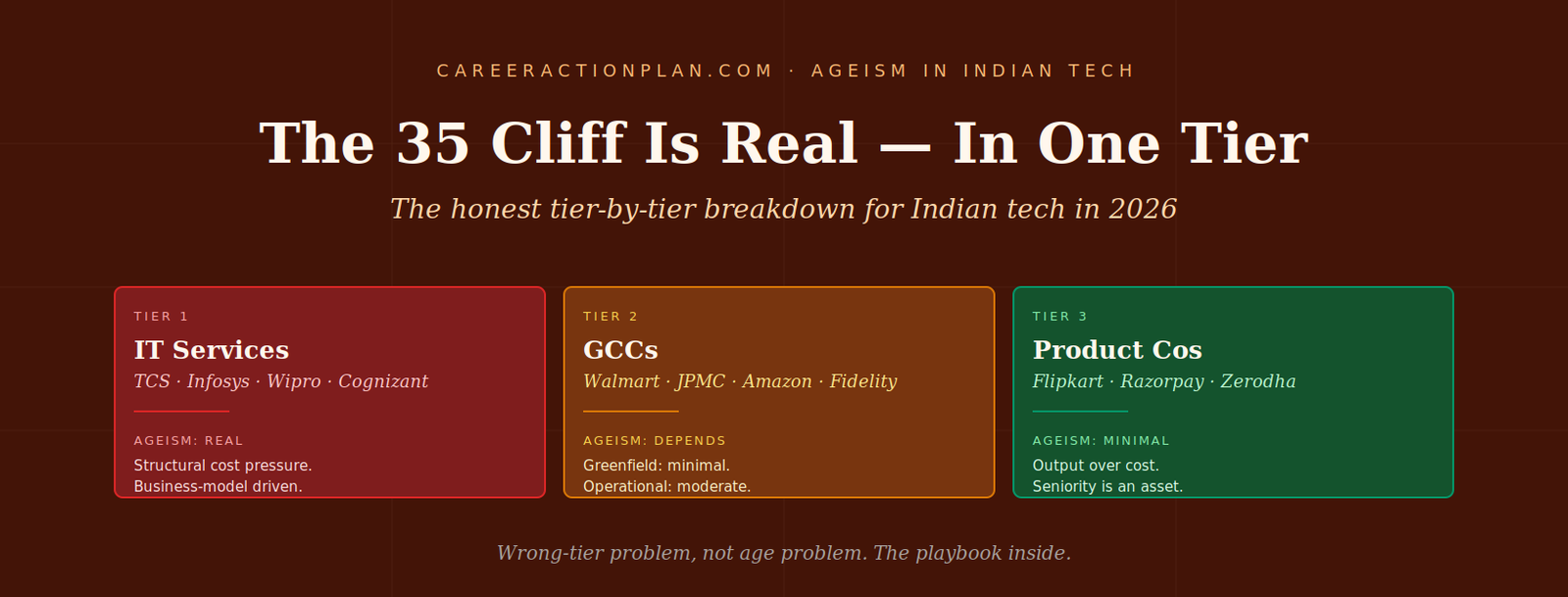
Here’s the argument the whole post rests on: ageism in Indian tech is not evenly distributed across the industry. It’s heavily concentrated in one tier of the market, present but manageable in another, and largely absent in a third. Once you see the tiers clearly, the fear stops feeling like a career-ending force and starts looking like a positioning problem you can solve.
IT Services — Where the 35 Cliff Is Real
TCS, Infosys, Wipro, Cognizant, Capgemini, HCL, LTIMindtree, Tech Mahindra, and the ecosystem of mid-tier services companies below them. This is where ageism in Indian tech is genuinely structural. The business model itself creates the pressure.
Service companies bill clients by billable-hour or fixed-price contracts. The gross margin on a fresher at ₹4 LPA billed at $30/hour is roughly 4x the gross margin on a 15-year veteran at ₹35 LPA billed at $50/hour. That math is why services companies aggressively renew their headcount at the junior end and quietly shed senior individual contributors. It’s not personal. It’s the P&L.
Add to this: NASSCOM’s own 2025 sector review flagged that services companies are restructuring 20-30% of their mid-senior technical workforce as they pivot to AI-enabled delivery models. Recent public reporting in the Economic Times on TCS alone mentions 24,000+ mid-senior role reductions in FY26. The 35-cliff in services isn’t paranoia — it’s a business decision playing out at scale, and it’s arguably the sharpest edge of ageism in Indian tech today.
Global Capability Centres (GCCs) — Where the Ageism in Indian Tech Story Gets Complicated
Walmart Global Tech, JPMorgan, Wells Fargo, Goldman Sachs, Fidelity, Cisco, Salesforce India, Adobe India, VMware India, Databricks India, and the many other GCCs of global product and financial services companies. This tier is more nuanced.
The good news: GCCs pay senior IC compensation seriously. A Staff-level SRE, senior data engineer, or principal software engineer at a GCC in Bangalore in 2026 can earn ₹45-70+ LPA at 12-18 years, and the role expects real senior technical work — not just people management. Comparative data on senior software engineer compensation across Indian tech consistently shows GCC compensation running 40-60% above equivalent-experience IT services compensation.
The complicated news: GCCs quietly split into two very different sub-tiers. One sub-tier does greenfield engineering — new products, new platforms, real invention. The other sub-tier does operational engineering — running and maintaining what was invented at headquarters. Both are labelled “senior engineering.” Only one pays and behaves like it.
If you’re in a GCC that operates rather than invents, the ageism pattern starts to look more like the IT services pattern by year 15-16 — quiet plateau, capped compensation, restructures that hit senior ICs harder than juniors. If you’re in a GCC that invents, age barely matters — seniority is an asset, and the specific compounding of 15+ years is what makes you valuable.
Indian Product Companies & Well-Funded Startups — Where Ageism in Indian Tech Barely Exists
Flipkart, Razorpay, Zerodha, PhonePe, Zomato, Swiggy, Freshworks, Postman, and the well-funded product companies at Series C and beyond. This is the tier where senior IC careers actually work, and where the 35-cliff conversation is mostly foreign to how these companies think.
Product companies compete for engineering talent based on what you can ship, not what you cost. A senior IC who has actually built and scaled systems is worth more than three mid-level engineers who haven’t. Age doesn’t figure into the equation — output does. If anything, product companies value 15+ years of engineering scar tissue heavily, because they’ve watched what happens when they hire only junior-to-mid engineers into hard problems.
The catch: this tier is hard to break into laterally. Product companies at senior IC level hire heavily from other product companies, from GCCs, and from previous employees. Breaking in from a pure IT services background at 15 years experience is meaningfully harder than breaking in at 8 years experience. Not impossible. But you have to know the game before you play it.
What “Ageism” Often Actually Is
Now the uncomfortable second layer. Even inside the tiers where ageism in Indian tech is genuinely real, a significant portion of what gets called “ageism” is actually one of three other problems in disguise. Naming them separately matters because they have completely different fixes.
1. Skill obsolescence disguised as age discrimination
The most common one. A 40-year-old engineer who last learned something new in 2018 is not being discriminated against for age — they’re being passed over for skill relevance. The signal reads as “he’s too old for us” but the underlying pattern is “his skills haven’t kept up with what we hire for.”
Here’s the honest test: what did you learn in the last 12 months that you didn’t know before? If the answer is “nothing substantive,” the ageism you’re worried about might actually be skill drift. That’s a much more fixable problem — but only if you diagnose it correctly.
2. Cost anchoring — “we can hire two juniors for what you cost”
This one is real, and it hurts. If your compensation has grown 8-10% annually for 12-15 years, you might now cost 3-4x what a fresh mid-level engineer costs. In roles where a 40-year-old adds 4x the value of a mid-level engineer, this doesn’t matter. In roles where the value ratio is closer to 1:1 or 2:1, cost anchoring becomes the real conversation — even if it never gets said out loud.
This is one of the reasons the tier breakdown matters. In IT services, the value ratio is often 1:1 or worse (juniors can be trained to close tickets almost as well as seniors). In product companies, the value ratio is often 4:1 or better (senior ICs can architect systems juniors can’t).
3. Positioning mismatch — the résumé doesn’t tell a specialist story
The generic senior engineer résumé is easy to reject at 40 in a way it isn’t at 30. When you’re 30, “8 years of full-stack development across three companies” reads as promising generalist experience. When you’re 40, the same résumé structure reads as “hasn’t specialized enough to be worth senior compensation.”
The fix isn’t to become more junior. It’s to become more specific. A résumé that clearly signals “10 years of Kubernetes-at-scale specialization with three named production migrations” reads completely differently from “senior engineer with cloud experience.” Positioning at 40 has to be sharper than at 30. That’s not ageism — that’s the market working correctly.
The 5 Factors That Correlate With Staying Employed Past 40
Now the constructive half of the post. If ageism in Indian tech is largely a tier-and-positioning problem, then the engineers who navigate it well should show consistent patterns. And they do. Watching peers in their late 30s and 40s across the Indian tech industry for a decade, five factors show up repeatedly in the careers that keep compounding — and their absence shows up repeatedly in the careers that stall. Not scientific. Pattern-recognition from close range.
Factor 1: Specific specialization, not generic seniority
The engineers doing best past 40 are known for something specific. Kubernetes at scale. Payment systems at high throughput. Data platforms for financial services. Observability across microservice fleets. Something narrow enough that when a hiring manager thinks about the problem, your name comes to mind. Generic “senior engineers” get squeezed. Specific senior engineers don’t.
Factor 2: A network that can vouch for you
The most reliable path to a senior role at 40 is not applying through Naukri. It’s a former colleague at the target company sending your résumé to the hiring manager with a personal note. Every senior engineer I know who navigated their 40s well spent the previous decade quietly maintaining relationships — not networking events, just staying in genuine touch with 20-30 people across the industry. That network becomes your job market at 40.
Factor 3: Public evidence of your work
A live LinkedIn presence with substantive technical content. A GitHub profile that reflects actual engineering, not tutorials from a decade ago. A blog, or a talk, or a conference contribution — something searchable that lets a hiring manager verify your work exists outside the walls of your previous employers. This is where GitHub optimization and LinkedIn positioning compound most heavily.
Factor 4: Tier fit — you’re in the right part of the market
The single sharpest correlation. Engineers past 40 who are in product companies or greenfield GCCs report almost none of the ageism in Indian tech pressure that IT services engineers report at the same experience level. If you’re 12+ years in and the ageism narrative is closing in on you, the first honest question isn’t “how do I fight ageism” — it’s “am I in the tier where my age is actually a liability, and if so, can I move.”
Factor 5: An architect or leadership optionality, kept warm
The IC track past 40 is real and viable — if you’re a specialist. But the engineers with the most durable careers past 40 also keep an architect track or a lead/manager track warm as an option. Not necessarily switching. Just staying credible for either path. This gives you optionality when your current role or company shifts, and optionality is what compounds resilience across a 20-year career.
The Specialist Premium vs the Generalist Squeeze
Of the five factors above, Factor 1 — specialization — deserves its own extended treatment because it’s the single most misunderstood dynamic in the Indian tech senior career market.
The received wisdom for the first 8-10 years of an engineering career is be a generalist, take varied experiences, stay flexible. That’s mostly good advice for the first decade. It becomes actively harmful advice in the second decade.
Here’s why. When a company is hiring a senior engineer at 15+ years experience, they are not hiring for potential — they’re hiring for specific value. And specific value comes from depth in a domain, not breadth across many. A 15-year full-stack generalist competes against 5-year full-stack engineers who cost half as much and have almost as much breadth. A 15-year Kubernetes specialist competes against 8-year Kubernetes engineers who lack the specific scars of running production Kubernetes at scale — and there’s no substitute for those scars. This dynamic is the single biggest reason ageism in Indian tech hits generalists hardest.
The uncomfortable implication: if you’re 12+ years in and you can’t answer the question “what am I specifically known for?” in one crisp sentence, you have a specialization problem, not an age problem. And the fix — deliberately specializing over the next 24 months — is entirely within your control.
What specialization looks like practically:
- Depth over breadth in your next role change. When you switch jobs next, prioritize roles that let you go deeper in your strongest domain over roles that expose you to new domains. Depth compounds. Breadth stops paying dividends after ~10 years.
- External signal of the specialization. GitHub reference implementations, LinkedIn posts, a blog, a conference talk — public evidence that you own a specific domain. This is what makes the specialization discoverable.
- Refuse the “senior generalist” trap. Managers love handing senior generalists whatever work needs doing. It feels flattering. It’s slowly killing your specialist positioning. Learn to say “that’s outside my area — I can help scope it, but you’d get better work from someone in that domain.”
The Tier-Switch Playbook
If the tier breakdown is right, then the highest-leverage move for many senior engineers stuck in IT services is not to fight ageism in Indian tech from inside services — it’s to move tiers. Here’s what that actually takes at 12-18 years experience.
The realistic timeline
Moving from IT services to a product company or greenfield GCC at 12-15 years experience typically takes 6-12 months of deliberate work, not 6-12 weeks. Anyone telling you it takes a couple of months hasn’t done it recently. The work compounds — but it’s real work, sustained.
The four moves that make it possible
1. Skill rebuild toward the tier you’re targeting
Product companies and greenfield GCCs hire for hands-on modern skill sets. If you’ve spent the last decade doing services work with dated tech, you need to rebuild toward what your target tier hires for — usually some combination of cloud infrastructure (AWS/GCP), containers and orchestration (Kubernetes), infrastructure-as-code (Terraform), and observability tooling. This is 3-6 months of deliberate learning, hands-on. Not optional.
2. Public evidence that you have the skills
Your résumé claims about modern skills won’t be trusted from a services background. Public evidence closes that trust gap. A GitHub profile with reference implementations of the tech stack you’re claiming. A LinkedIn presence engaging with topics in your target domain. Optionally a blog or newsletter. This runs in parallel with Move 1 — you’re publishing what you’re learning as you learn it.
3. Network cultivation into the target tier
Reach out to 20-30 people currently working in your target companies. Not asking for jobs. Asking for genuine conversations — what does their team do, what do they hire for, what does the interview process look like. Most senior engineers you approach this way will engage. Those relationships become your referral pathway when the roles open. This is the highest-leverage single activity in the whole playbook.
4. Interview preparation calibrated to the new tier
Product companies and greenfield GCCs interview differently from IT services. Coding rounds are real. System design rounds are serious. Behavioral interviews use frameworks like STAR and expect crisp examples. Preparation has to be deliberate — 4-8 weeks of active interview prep before you start applying seriously, or your first 20 attempts get burned on interviews you weren’t ready for.
When it’s worth doing — and when it isn’t
The tier switch isn’t the right move for everyone. Three questions to be honest with yourself about:
- Do you have 6-12 months of runway (either employed at your current job or with savings) to do the work properly?
- Are you willing to accept a 6-12 month period of lower income and higher stress for a step-change in trajectory?
- Is your current situation actually bad enough to warrant the disruption, or are you catastrophizing based on Blind posts?
If yes on all three, the tier switch is probably the highest-leverage career move you can make. If no on any of them — especially the third — sometimes the honest answer is to stay in your current tier, do the work of specialization in place, and revisit the tier switch decision in 18 months from a stronger position.
My Story — What I’ve Watched Across a Decade
I’m not going to write this section from outside the problem. I’m in it. I’m in my late 30s. I’ve watched close friends navigate exactly what this post describes — some well, some badly.
The peer who did it well I remember most clearly was in an IT services role until about year 12. Solid engineer, generalist, decent pay, plateauing quietly. He made a decision most people around him didn’t understand at the time — he took an evening role at a small product company (technically a moonlighting risk, but a calculated one) to rebuild his hands-on skills. Eighteen months later, that product company hired him full-time at a step-change compensation. He’s now four years into that trajectory, at a senior IC level he would never have reached in the services company he left. The lesson wasn’t “leave services.” The lesson was that the tier switch is a project, not a résumé send.
The peer who did it badly was the opposite. Same starting point — 12 years in IT services, plateauing. But he waited for the market to solve his problem instead of solving it himself. Applied to hundreds of roles when the layoff hit at year 15, from a positioning that his target companies couldn’t decode. Eventually landed something, but at a lateral move, not a step-up. The 3-4 years of runway he’d had before the layoff — years he could have used to reposition — were largely wasted on the assumption that his current role would continue.
What I’ve internalized from watching both patterns: the ageism narrative is a trap that convinces you the problem is external and inevitable. It isn’t. The problem is almost always specific — wrong tier, wrong specialization, wrong network, no public evidence. Each of those is fixable if you start early enough. The engineers who thrive past 40 in Indian tech are almost never the ones who denied ageism existed. They’re the ones who diagnosed their specific situation clearly and did the work.
I’m doing that work now, in real time. I don’t have a clean success story to hand you yet — I’m still inside the problem, in my late 30s, writing this. What I can tell you is that clarity about the tier structure, honest self-assessment of specialization, and deliberate network cultivation are the moves I’m making. This post is partly me thinking out loud about my own next 5 years, using material I wish someone had put together for me at 35.
A Word Directly to You
If you’re 35+ in Indian tech and this post has raised your anxiety more than it’s calmed it, take a breath. The situation isn’t as dire as Blind threads suggest. It’s also not as fine as the “just upskill” advice suggests. It’s in the middle — a real, structural, addressable challenge that responds well to deliberate work and badly to panic.
Here’s the honest short version of everything above:
One: Identify which tier you’re currently in. Be honest — services, operational GCC, greenfield GCC, or product. That’s the single biggest factor in your ageism exposure. If you’re in the wrong tier for your career stage, that’s the highest-leverage thing to work on.
Two: Diagnose whether what you’re calling “ageism” might partly be skill obsolescence, cost anchoring, or positioning mismatch. Those are individually more fixable than the giant undifferentiated fear.
Three: Pick one specialization to lean into over the next 24 months. Not five. One. Depth compounds. Breadth stops paying past year 10.
Four: Build public evidence — GitHub, LinkedIn, maybe a blog — that lets a hiring manager verify your specific work exists outside your employer’s walls.
Five: Cultivate a network of 20-30 people in the tier you want to be in. Not networking events. Real relationships, sustained over years.
Do these five things starting this quarter and the ageism conversation stops being about you three years from now. It doesn’t mean ageism in Indian tech disappears from the industry — it doesn’t. It means you become the engineer that ageism doesn’t apply to, because you’ve done the specific work that makes age irrelevant to your value.
That’s the honest answer. And it’s the one I’m working on in my own career, right now, at exactly the age this post is about.
This Post Is Not the End of the Discussion
One last thing, and I want to say this clearly. This post is not the last word on ageism in Indian tech. It’s my current best working theory, built from a few months of research and a decade of watching peers. It’s meant to start a discussion, not close one.
I’m openly rooting for two kinds of conversations from this piece.
From peers — engineers in their late 30s and 40s who are living this pattern in real time. Does the tier breakdown match what you’ve seen? Where would you push back? What have I missed? The comments and DMs from readers like you are the fastest way this framework gets sharper.
From seniors — engineers with 20+ years in Indian tech who’ve watched multiple cycles of this. You’ve seen the pattern longer than I have. Your corrections and additions matter more than mine. If you disagree with the tier framework, tell me why. If you’d add a factor I missed, share it. If your career has taken a shape my framework doesn’t explain, I want to hear about it — because that’s exactly the signal I’m calibrating against.
This is an open topic. I’m not the expert on it — I’m a peer trying to figure it out out loud, hoping the figuring-out is more useful shared than kept private. If this post helps someone in your network navigate their own next five years better, share it. If you have a sharper reading than mine, publish yours — the industry needs more honest writing on ageism in Indian tech, from more voices, not less.
Rooting for all of you.
— Arvind
Quick Reference — The Ageism in Indian Tech Playbook
The Sharp Claim
The 35 cliff is real in IT services. It barely exists in product companies and GCCs. Wrong-tier problem, not age problem.
Where Ageism Actually Lives
- IT services (TCS, Infosys, Wipro, etc.): REAL — structural cost pressure, business-model driven
- Operational GCCs: MODERATE — quiet plateau by year 15-16
- Greenfield GCCs: MINIMAL — invention values seniority
- Indian product companies & funded startups: MINIMAL to ABSENT — output over cost
What “Ageism” Often Actually Is
- Skill obsolescence disguised as age discrimination
- Cost anchoring (2 juniors for what you cost)
- Positioning mismatch — generalist résumé at 40
5 Factors That Correlate With Staying Employed Past 40
- Specific specialization, not generic seniority
- A real network that can vouch for you
- Public evidence of your work
- Tier fit — you’re in the right part of the market
- Architect / leadership optionality kept warm
The Tier-Switch Playbook (6-12 months)
Skill rebuild → public evidence → network cultivation → tier-specific interview prep. Worth doing if you have runway, willing to accept short-term stress for step-change trajectory, and situation is actually bad enough to justify disruption.