It’s a Tuesday night in late November. My one-year-old kid is finally asleep in the next room after a long bedtime. The home-loan EMI notification pinged twice today. I have a trip in few days that I haven’t packed for, a Lead Platform Engineer role I’ve been quietly chasing for three months, and a stack of AI tools everyone on LinkedIn keeps telling me I should have mastered six months ago.
I am a Lead Platform Engineer and SRE with 15+ years of experience in Indian tech. I write a career-strategy blog. And I am also, right now, the exact person this post is about: a 35+ senior engineer whose growth path feels foggy, whose study time has evaporated, whose plans are not going as planned, and who is quietly figuring out how to use AI not as the thing that replaces him but as the thing that keeps him in the game.
This is the honest 2027 guide to AI for senior engineers at that specific life stage — married, parent to a young child, EMIs stacking, 10-15 years into a career that was supposed to feel more settled by now. If you are in that same squeeze, this post is for you. It is also, as much as anything I have written, a post about me — written in real time from inside the same problem.
WHAT THIS AI FOR SENIOR ENGINEERS GUIDE COVERS
- The 35+ senior engineer trap — why career demands and life demands are both going up at the same time, and why the standard “just upskill” advice fails at this life stage
- The brutal math of time — what 3-5 hours a week actually buys you, and why AI for senior engineers is a leverage conversation, not a learning conversation
- How I am actually using AI as a career co-pilot — the honest working stack, including the post you are reading right now
- The 5 AI leverage moves that survive the 35+ time squeeze
- What AI cannot do for you — the limits section nobody writes, so you do not waste your scarce time chasing the wrong things
This is a longer piece — about 15-18 minutes end to end. If you are pressed for time (and you probably are), read sections 3 and 4 first. Those two sections carry most of the practical weight.
1. This Is My Actual Tuesday Night (And Probably Yours Too)
I started writing this post at 10:32pm after my kid finally slept. I am typing it in short bursts, with a cup of tea going cold beside the laptop, and with the awareness that I need to be up at 6:30am for a work call. I have exactly ninety minutes to write something worth reading, or it will not get written at all this week — and this week was supposed to be the week I finally published it.
My last blog post, a technical-career piece on portfolio projects for Lead Platform Engineer interviews, took me three weeks to publish and did not perform the way I hoped it would. My GitHub repo is quietly getting inbound traffic but the Lead Platform Engineer interviews I lined up this quarter have been rejected three in a row. My own 2025 hike was in line with every other senior engineer I know — which is to say, well below inflation. And every single LinkedIn feed scroll tells me I need to be posting more, learning more, building more, networking more.
This is not a complaint. It is a status report from inside the exact life stage this post is about. If the picture feels familiar, you are not alone in it. And if you are a 35+ senior engineer reading this on your own Tuesday night, between a child’s bedtime and your laptop closing, we are in the same room.
Here is what I believe nobody in the Indian career-writing space is saying honestly enough: the 35+ senior engineer in 2026 is in a structurally different situation than the 25-year-old engineer who most career advice is written for. The playbooks that worked at 25 — grind more, learn more, hustle more, build in public — do not just fail at 35+, they are actively harmful. They tell you to spend time you do not have, on things that may not compound, while ignoring the specific leverage that is available to you precisely because of your experience.
This post is my attempt to write the playbook I wish existed for me right now. It is centered on one specific tool — AI, and specifically AI agents and assistants used well — because that is the one leverage multiplier that actually matches the 35+ senior engineer’s time budget. Everything else is a nice-to-have. This one, I have come to believe, is a must-have.
2. The 35+ Senior Engineer Trap: Career Demands UP, Life Demands UP
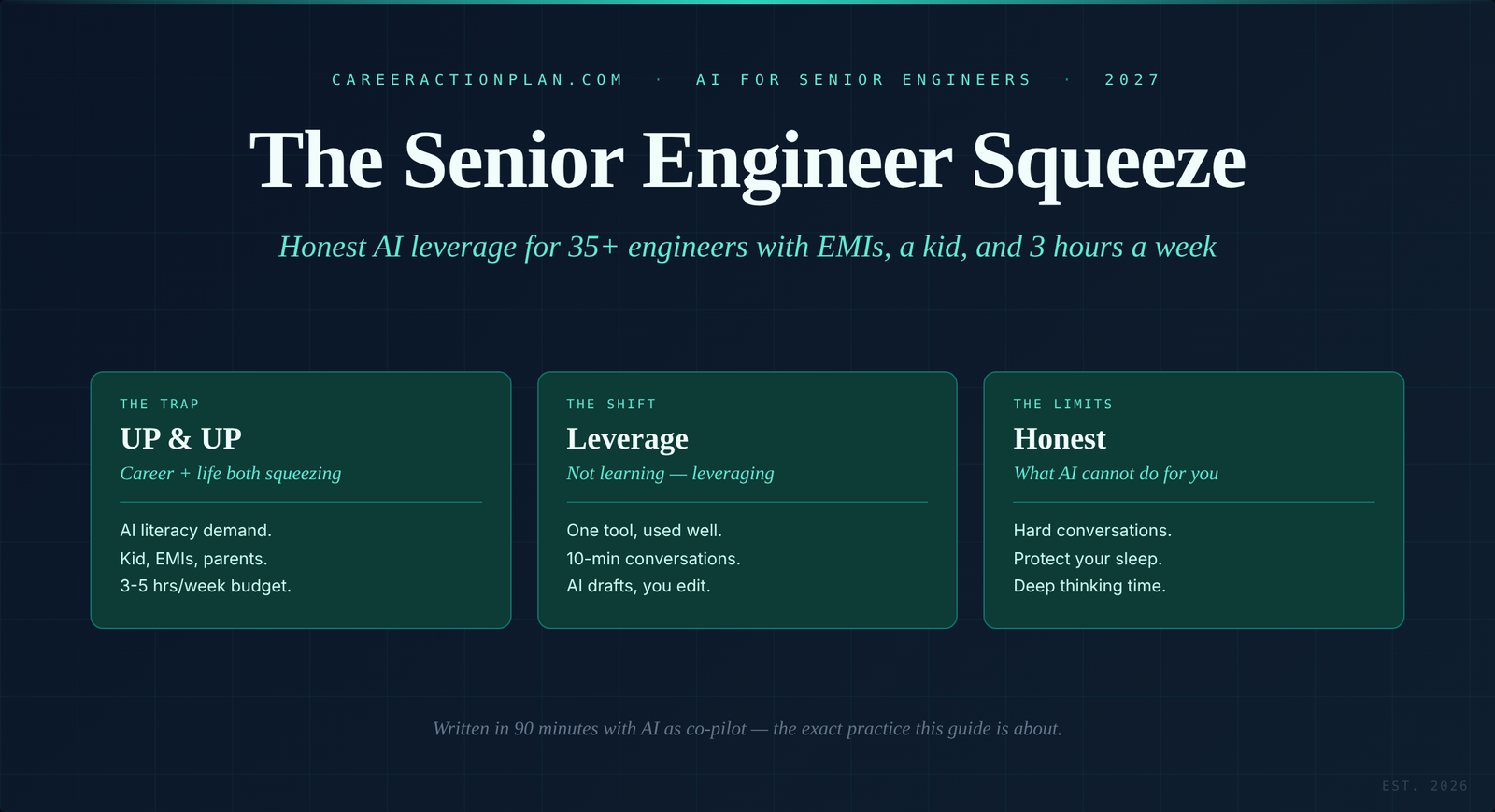
Before the practical half of this guide, the diagnosis. If you do not understand the structural squeeze, you cannot pick the right lever to pull against it. And the squeeze on the 35+ senior engineer in Indian tech in 2026 is specific and nameable. It comes from three directions at once.
Career demands going up
- Specialization expectation — generic senior engineers are getting squeezed; the market wants specific, deep, defendable expertise
- AI literacy — companies now expect every senior IC to use AI tools fluently, and the tools change every three months
- Visibility work — a LinkedIn presence, GitHub activity, external evidence of your work is now part of the base expectation, not an extra
- Soft-skill ceiling — the Lead / Staff promotion requires influence, mentoring, cross-team work, which eats evening and weekend hours
Life demands going up at the same time
- Kid time — bedtime, school prep, weekend activities, and the sheer cognitive load of parenting a young child
- EMIs — home loan, car loan, maybe your parents’ medical bills; the salary you thought was comfortable at 30 feels tight at 35
- Elderly parents — doctor visits, insurance work, their medications, the slow slide of their health demanding your attention
- Your own health — the first real body signals that forty is close and the twenty-year-old body does not come back
- Partner and family — a marriage needs active time, not residual time
And the stress tax on top of all of it
Even if you had the hours, the specific exhaustion of this life stage means those hours are lower-quality. The two hours a 25-year-old gets after dinner are not the same as the two hours a 35+ parent gets at 10:30pm. One is sharp, one is tired. Standard career advice ignores this entirely and tells you to “just put in the time.” The advice is, on its own terms, incomplete at best and dishonest at worst.
3. Why “Just Upskill” Advice Fails AI for Senior Engineers at 35+
Let us do the brutal math. A 35+ senior engineer with a full-time job, a child under 5, EMIs, aging parents, and a marriage realistically has 3 to 5 hours per week of genuinely focused learning or career-building time. Not 10. Not 15. Three to five, after you subtract commuting, family, sleep, basic exercise, and the daily surface-level upkeep that keeps a working professional functional.
The LinkedIn and YouTube advice on AI for senior engineers almost universally assumes 10-15 hours per week of focused self-improvement time. “Just master Claude, ChatGPT, Cursor, and the latest agentic workflows!” Three tools, each with a 20-hour learning curve, in a market that updates every 90 days. That is 60 hours just to get to baseline, and then the tools change again.
At 3-5 hours per week, that math does not close. Not in 2026, not in 2027, not ever. The engineer trying to follow that advice ends up perpetually behind, perpetually guilty, and perpetually stressed — which further degrades the quality of the few hours they do have. It is a trap.
The honest AI for senior engineers conversation is not a learning conversation. It is a leverage conversation. You do not need to master every tool. You need to use one or two really well — well enough that each hour of your remaining time produces three or four hours of output.
Once I internalized this shift — from “learning AI” to “leveraging AI” — the stress dropped noticeably, and the output went up. The rest of this post is the concrete working version of that shift.
4. How I’m Actually Using AI as My Career Co-Pilot (My Honest Working Stack)
This section is the one I think nobody else in the Indian career-writing space is willing to write honestly. Most AI-and-career posts are either (a) breathless tool reviews, or (b) vague “AI will transform your career!” platitudes. Neither is useful at 10:30pm on a Tuesday when you have ninety minutes and need something to happen.
Here is my honest working stack as a 35+ senior engineer using AI for senior engineers’ real problems in late 2026. Not what I think I should be doing. What I am actually doing, this week.
Writing this blog post (right now, in real time)
I did not write this post from a blank page. I started with a 5-minute brain dump into an AI assistant — my current situation, the three pain points I wanted to address, the kind of reader I was writing for, and the signature voice I use on this blog. The AI drafted a structure. I pushed back on half of it. It redrafted. I wrote the vulnerable opening scene myself because that part cannot be outsourced. For the middle sections, I dictated the key ideas in bullet form and let the AI expand into paragraphs, which I then edited for voice. Total active time from idea to publish-ready draft: about 90 minutes. Without AI: this would be a six-to-eight-hour piece spread across three evenings I do not have.
Debugging my paved-road AI inference infrastructure project
Last month I built a public reference architecture for serving LLMs on EKS. It involved three overnight debugging sessions on issues nobody had documented before — EKS silently rejecting Karpenter-provisioned GPU nodes, KServe injecting default readiness probes that killed my model loads, KV cache math on a 16GB T4. For each one, I pasted error logs into an AI assistant and had back-and-forth conversations. Not “write me the fix” — more like “here is what I am seeing, here is what I tried, what am I missing?” The AI was wrong about half the time. But the half it got right compressed my debugging from a week to a weekend.
Strategic career thinking when I am too tired to think
This is the one almost nobody talks about. At 11pm after a long day, I do not have the cognitive energy to strategize about my next career move. But the AI does. I use it as a thinking partner — “here is my current situation, here are the two options I am weighing, what am I not considering?” The AI gives me a structured breakdown I can read in 5 minutes and sleep on. Half the suggestions are obvious. A quarter are wrong. A quarter are things I genuinely had not considered. That quarter is why I use it.
Keeping the 100-day career plan moving when energy is low
I have a structured 100-day plan to break into a Lead Platform Engineer role. Some weeks I have energy, most weeks I have less. When I have less, I open the AI, paste the week’s goals, say “I am exhausted, what is the smallest step I can take this week that still moves the plan forward,” and the AI gives me a scoped-down version. That version actually gets done. The ambitious version would not have.
Fast research instead of slow reading
Instead of reading three blog posts and a documentation page to understand a new concept, I have a 10-minute conversation with an AI. I ask it to explain, push back on points that do not match my mental model, ask for the edge cases. I retain 60% of what I would have retained from reading — but the reading would have taken an hour I did not have. The 60% retention in 10 minutes beats 90% retention that never actually happens.
Every one of the above is me using AI for senior engineers’ real problems — not as a toy, not as a demo, not as something I am “exploring.” As a daily leverage tool, calibrated to my actual 3-5 hours a week of focused time.
5. The 5 Leverage Moves: AI for Senior Engineers Who Are Short on Time
If you take nothing else from this post, take these five moves. Each one is explicitly designed around the 35+ senior engineer’s 3-5 hours a week budget. None require you to master a new tool from scratch. All are available to you starting tomorrow. This is the practical core of AI for senior engineers at this life stage.
Replace Tutorials With Conversations
When you need to learn something new — a framework, a concept, a tool — do not watch a 45-minute YouTube tutorial. Open an AI assistant and have a 10-minute conversation. Tell it what you already know. Ask it to teach you the parts you do not. Push back when something does not match your intuition. You will retain less than the YouTube tutorial. You will also finish in a tenth of the time and actually apply what you learned the same evening. At the 35+ life stage, applied knowledge in 10 minutes beats theoretical mastery in 45 that you never use.
Use AI for the First Draft of Everything
Every email you write. Every design doc. Every blog post. Every performance-review self-assessment. Every difficult conversation you need to script in advance. AI drafts the first version in 60 seconds. You spend 15 minutes editing it into something that sounds like you. You save 45 minutes per artifact. Over a year, this is hundreds of hours of cumulative time back. The editing step is critical — the AI’s first draft is never publishable — but editing is much faster than drafting, especially when you are tired.
Pair-Program and Pair-Debug, Don’t Just Ask for Code
The wrong way to use AI for code is to ask it to write a function and paste the output. The right way is to pair with it: tell it what you are trying to do, show it what you have tried, ask what you might be missing. Treat the AI like a thoughtful colleague with uneven expertise — sometimes brilliant, sometimes confidently wrong — whose primary value is the dialogue itself, not the final artifact. The dialogue compresses the time you would have spent reading documentation, Stack Overflow, and your own old code into a focused 15 minutes.
Externalize Your Thinking When You Are Tired
Your 10:30pm brain is not your 10:30am brain. But you still need to make decisions, strategize, plan. Use AI as a thinking externalization layer. Dump your current situation into it in half-formed sentences. Ask it to structure what you are saying. Ask it to point out what you are not considering. Read its response. You are not asking the AI to think for you — you are asking it to hold the cognitive load of structure while your tired brain focuses on judgment. Judgment is the one thing the AI cannot do for you. Everything else, it can carry temporarily.
Build a 30-Minute Daily Loop, Not a 3-Hour Weekend Session
The 35+ senior engineer’s weekend is not actually available for focused learning. Family, errands, household, maintenance — the 3-hour Saturday block is a fantasy. What is actually available is 30 minutes most weekdays, usually late evening. Design your AI-augmented learning around that cadence. Pick one topic per week. Spend 30 minutes a day on it, AI-assisted. In 2.5 hours across the week, you will cover more ground than the 3-hour Saturday session you never actually get to.
6. The Honest Limits — What AI Cannot Do For You
Every honest guide needs a limits section, and the honest conversation about AI for senior engineers is no exception. Here is what AI genuinely cannot do, so you do not waste your scarce 3-5 hours chasing the wrong thing.
AI cannot do the hard interpersonal work for you. The difficult conversation with your manager about your scope. The sponsor relationship you need to build with a skip-level. The vulnerability of asking a senior engineer in another company to be your informal mentor. These are human-to-human moves. AI can help you prepare the script. It cannot replace the conversation.
AI cannot give you energy you do not have. You still need sleep. You still need exercise. You still need unstructured time with your partner and your child. The temptation of AI leverage is to try to cram more into the day with the time you save. Do not. The time AI gives you back belongs partly to your career, partly to your rest, partly to your family. Spending all of it on “more career” is the fastest path to burnout at this life stage.
AI cannot fix structural career problems. If you are in a dying tier — an IT services role that is quietly shedding its senior ICs, a stagnant team with no Lead seats opening — no amount of AI leverage will save you. AI makes you faster and sharper. It does not change the underlying game you are playing. If the game is wrong for you, you still have to switch games. AI can help you plan the switch; it cannot execute the switch for you.
AI cannot replace deep, uninterrupted thinking entirely. For the hardest strategic decisions of your career — should I leave this company, should I move cities, should I pivot into a different technical area — you still need the long walks, the showers, the drives where your mind actually integrates everything. AI accelerates many things, but it does not replace the quiet integration time that real judgment requires. Protect that time.
The honest conversation about AI for senior engineers is about leverage within clear limits, not magical replacement. The engineers at this life stage who will thrive are the ones who use AI aggressively for the things it is good at, protect their time ferociously for the things only they can do, and stop feeling guilty about not being everywhere at once. That is the entire playbook for AI for senior engineers in 2027.
A Word Directly to You
If you are reading this at 10:30pm on your own Tuesday, after your own child’s bedtime, with your own EMI notifications in your phone and your own career plans feeling fogged over — I want you to hear this clearly.
You are not failing. The game changed under you while you were building the rest of your life. You went from a 25-year-old with 20 hours a week of free time to a 35+ parent with 3-5 — and nobody updated the career advice for that transition. You have been following a playbook written for someone with a completely different life budget.
The honest version of AI for senior engineers in 2026-2027 is simpler than the LinkedIn noise makes it sound. The right approach to AI for senior engineers is not about mastering every new tool. It is not about posting more. It is not about hustling harder. It is about using one or two AI tools really well, inside the scarce hours you actually have, so that each hour produces three or four hours of output. Then protecting the rest of your time — for your family, your health, your rest — without guilt.
That is the playbook. It fits on a sticky note. It is also, I am now convinced, the only career playbook that actually works at 35+ in this decade.
I am testing it on myself in real time, right now, in late November 2026. In 90 days I will publish the honest follow-up — what worked, what did not, and whether this reshape of my relationship with AI actually produced the Lead role I am chasing. Including if it did not.
If this post helped — share it with one senior engineer friend who is in the same squeeze. And if you want to compare notes on your own AI-leverage setup, DM me on LinkedIn. I read everything. I reply to most things. We are all in this together.
Rooting for all of you.
— Arvind
Quick Reference — AI for Senior Engineers at 35+
The Sharp Claim
At 35+ with a family and EMIs, AI for senior engineers is not a learning conversation — it is a leverage conversation. Use one or two tools well; stop trying to master all of them. That reframe alone decides whether AI for senior engineers is a stress multiplier or a stress reducer at this life stage.
The Time Reality
- 3-5 hours a week of focused learning time (not 10-15)
- Most of it in late-evening 30-minute windows, not Saturday 3-hour blocks
- Those hours are lower-energy than the 25-year-old’s hours — design around that
The 5 AI Leverage Moves
- Replace tutorials with 10-min AI conversations
- Use AI for first draft of every email, doc, post, script
- Pair-program and pair-debug, do not just ask for code
- Externalize tired-brain thinking to AI for structure
- 30-minute daily loops beat 3-hour weekend fantasies
What AI Cannot Do
- The hard interpersonal work (your manager, your sponsor, your mentor)
- Give you energy you do not have (protect sleep, family, health)
- Fix structural career problems (wrong tier, dying team)
- Replace deep uninterrupted thinking for the biggest decisions
The Reframe
You are not failing. The game changed under you. Use AI aggressively. Protect your time ferociously. Stop feeling guilty about not being everywhere.